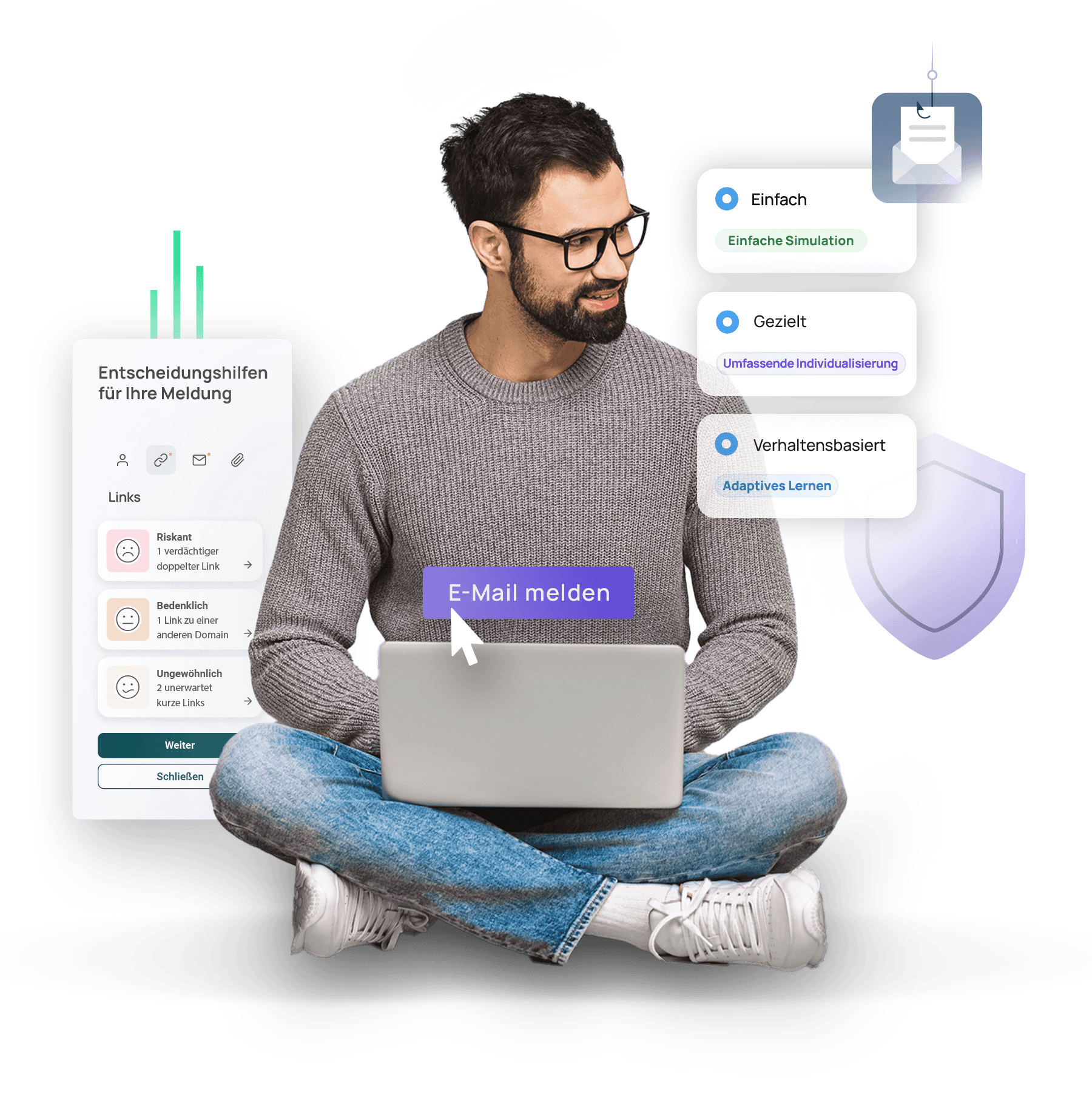
AI governance works better when employees know what to look out for in day-to-day work. SoSafe supports this with security awareness training that helps teams recognise AI-related risks and make safer decisions in the moment.
Compliance
AI governance in practice: ensuring compliance, managing risks, strengthening resilience
How organisations can implement AI governance in a structured and defensible way, from EU regulatory requirements to practical frameworks, tools, and employee enablement.
Contents
- Definition: What is AI governance?
- AI regulation
- EU AI Act compliance checker
- Standards
- AI governance frameworks
- Roadmap: Implementing AI governance
- AI governance tools
Overview: AI governance
- AI governance is becoming a regulatory requirement under the EU AI Act, with obligations introduced in phases from 2025 onwards and expanding over time.
- Clear roles, responsibilities, and policies help organisations maintain control and ensure traceability of AI-driven decisions.
- Frameworks such as ISO/IEC 42001 and the NIST AI Risk Management Framework provide structured guidance for implementation.
- Behaviour-based awareness training can support employees in recognising and responding to AI-related risks in everyday work.
- Combined governance tools enable ongoing monitoring, audit preparation, and compliance tracking across AI systems.
Definition: What is AI governance?
AI governance is the organisational and technical framework organisations use to manage, control, and take responsibility for how artificial intelligence is developed, deployed, and used.
It sets clear responsibilities, defines how risks are handled, and outlines expectations for transparency, security, and ethical use. This gives teams a practical structure for oversight, compliance, and audits.
AI regulation: creating legal certainty at global level
AI regulation is evolving quickly across regions. Governments and standardisation bodies are introducing rules and guidance on how organisations should use and control AI, with a mix of binding requirements and voluntary frameworks.
For organisations operating internationally, this can be difficult to track. Keeping a clear view of relevant requirements helps reduce compliance risk and supports more consistent governance across teams.
AI regulation: creating clarity in a changing landscape
AI regulation is evolving quickly across regions. Governments and standardisation bodies are introducing rules and guidance on how organisations should use and control AI, with a mix of binding requirements and voluntary frameworks.
For organisations operating internationally, this can be difficult to track. Keeping a clear view of relevant requirements helps reduce compliance risk and supports more consistent governance across teams.
International overview: where AI governance is already required or emerging
| Region | Regulation / Framework | Governance expectations | Legally binding |
| EU | EU AI Act | Yes | Yes (phased from 2025–2027) |
| USA | SR 11-7 (Model Risk Management) | Indirect (sector-specific) | Yes (for regulated banking institutions) |
| Global | ISO/IEC 42001:2023 | Yes | No (voluntary standard) |
| China | Interim Measures on Generative AI + related rules | Yes | Yes |
| Canada | Artificial Intelligence and Data Act (AIDA) | Yes | Not yet (pending legislation) |
| UK | Pro-innovation AI Regulation Framework | Indirect (sector-led guidance) | No (non-binding) |
The EU AI Act is one of the first comprehensive legal frameworks for regulating the use of artificial intelligence. It is already shaping how organisations approach AI governance, both within Europe and beyond.
It follows a risk-based approach, where obligations depend on how AI systems are used and the level of risk they pose. Organisations are expected to meet requirements around transparency, documentation, and risk management, particularly for high-risk systems.
These obligations are introduced in stages, with key requirements applying between 2025 and 2027. Organisations that start building governance structures early are better positioned to adapt as requirements take effect.
At the same time, regulations such as the NIS2 Directive increase expectations for cybersecurity and organisational resilience. In practice, this also brings more attention to human factors, such as how employees recognise risks and respond in real situations.
AI governance is no longer limited to voluntary best practice. In some regions, it is already enforceable, while in others it is shaped through sector-specific rules or emerging legislation.
For organisations operating across markets, the challenge is not just compliance. It is aligning governance approaches across different legal systems without creating parallel processes or added operational overhead.
EU AI Act compliance checker: Am I affected?
The EU AI Act does not apply only to technology providers. It can also apply to organisations that develop, place on the market, import, distribute, or use certain AI systems in the EU, depending on their role and how the system is used under the official EU AI Act.
A compliance checker can help teams make an initial assessment. It can show whether an AI use case may fall into a relevant category and which questions need closer legal or compliance review. It should be treated as a starting point, not a substitute for a full assessment. TheEuropean Commission’s AI Act timeline makes clear that obligations are phased: some rules have applied since 2 February 2025, the Act becomes broadly applicable on 2 August 2026, and some requirements for certain high-risk systems extend to 2 August 2027.
Within a broader AI governance programme, this early scoping step helps because organisations that know where AI is used, what risks are involved, and who owns each use case are in a better position to put the right controls in place before compliance work becomes urgent. That makes AI use easier to manage, easier to document, and easier to govern over time.
Standards: what AI governance should cover
Regardless of the size of the organisation, effective AI governance usually needs a few core elements:
- Risk assessments for relevant AI use cases.
- Clear documentation and ongoing oversight.
- Processes that support quality, review, and traceability.
- Defined responsibilities and decision-making controls.
- Alignment with data protection and cybersecurity processes.
- Training that helps employees understand risks and use AI more responsibly.
These building blocks can be structured through recognised standards such as ISO/IEC 42001:2023, which sets out a framework for establishing, implementing, maintaining, and continually improving an AI management system. It is a voluntary standard, but it gives organisations a practical way to manage AI-related risk while supporting accountability and continuous improvement.
Turn AI governance into everyday practice
Book a demo
Frameworks: guidance for AI governance
Effective AI governance needs more than legal compliance. It also depends on practical frameworks that turn legal, ethical, technical, and organisational expectations into processes teams can actually run.
Several international bodies have published AI-focused frameworks and standards that organisations can use as guidance. Some are certifiable standards, some are voluntary frameworks, and some are principles intended to support policy and decision-making.
The table below highlights some of the main AI governance frameworks in use today.
| Framework | Main purpose | Focus areas | Status |
| ISO/IEC 42001:2023 | Establishing, implementing, maintaining, and improving an AI management system | Governance, risk management, accountability, documentation, control | Published in 2023 |
| NIST AI RMF 1.0 (2023) | Helping organisations identify, assess, and manage AI risks | Governance, mapping, measurement, risk management | Released in 2023 |
| OECD AI Principles | Guiding trustworthy, human-centred AI use | Transparency, accountability, human rights, democratic values | Adopted in 2019, updated in 2024 |
| IEEE 7000-Serie | Addressing ethical and societal concerns in system and AI design | Transparency, bias, privacy, accountability, ethical design | Series includes active and published standards |
Practical tip: In practice, many organisations combine these approaches. For example, they may use ISO/IEC 42001 as the management system foundation, then draw on the NIST AI Risk Management Framework for more detailed risk work. That can create a more workable governance setup, especially when organisations need to balance compliance, internal accountability, and day-to-day operational use.
Roadmap: implementing AI governance
This roadmap gives organisations a practical way to build AI governance step by step, with clear ownership, workable controls, and evidence that supports oversight and compliance.
1. Map AI use cases and risks
Start by identifying where AI is already used or planned across the organisation. Include tools, data sources, integrations, and third-party systems. Then assess where these use cases could affect people, business processes, security, privacy, or regulatory obligations.
2. Define the governance structure
Assign clear ownership across legal, IT, security, data protection, and relevant business teams. Define roles and decision rights in a way that is easy to follow. For higher-risk use cases, set up a review process that covers approvals, exceptions, and documented risk decisions. Where relevant, this should connect with existing privacy, audit, and risk processes.
3. Set principles and internal rules
Establish clear principles for how AI should be used across the organisation. These often cover transparency, accountability, human oversight, documentation, and acceptable use. The goal is to make these principles practical enough to guide procurement, development, deployment, and day-to-day use.
4. Assess and classify AI risks
Review each use case based on its purpose, impact, and regulatory context. Under the EU AI Act’s scope and application rules, obligations depend on the role of the organisation and the risk category of the system. For higher-risk systems, that can include requirements linked to risk management, documentation, logging, human oversight, and cybersecurity. The European Commission’s AI Act timeline also makes clear that these obligations apply in phases between 2025 and 2027.If you use generative AI, extra checks may also be needed. In some cases, transparency obligations apply, such as marking or labelling AI-generated content. Security testing may also be appropriate for sensitive use cases, but it should not be treated as a blanket legal requirement for every AI deployment. The Commission’s guidance on general-purpose AI models is a useful reference point here.
5. Put data governance in place
Set rules for how data is selected, accessed, documented, retained, and deleted. This should cover data quality, provenance, permissions, and traceability. For AI systems, that also means being clear about which data is used for training, fine-tuning, grounding, or inference, and what controls apply at each stage.
6. Manage the full lifecycle
AI governance should cover the full lifecycle, not just deployment. That includes design, testing, release, monitoring, change management, and retirement. A structured lifecycle approach is also consistent with ISO/IEC 42001:2023, which sets requirements for establishing, implementing, maintaining, and continually improving an AI management system.
Where possible, connect this work to existing operational systems instead of creating a parallel process. For example, approvals, incidents, and change requests can often sit more naturally within established IT service management and risk workflows.
7. Build in security and guardrails
AI systems can introduce security risks such as prompt injection, unsafe outputs, data leakage, or misuse of connected tools. That is why organisations should define guardrails early, including monitoring, access controls, testing, and response processes. The exact controls will vary by use case, but security should be built into governance from the start, not added later. For high-risk AI systems, the EU AI Act regulatory framework also includes cybersecurity obligations.
8. Review third parties and supply chains
Third-party AI providers should be assessed with the same care as internal systems. Review how they use data, where processing takes place, what model dependencies exist, and what evidence they can provide. It is also worth checking audit rights, subcontracting, and how changes to the service are communicated. This matters because governance often breaks down at the supplier level, especially when teams rely on tools they did not originally procure themselves.
9. Build training and awareness
Employees need to understand how AI changes day-to-day risk, not just what the policy says. That includes knowing when to question outputs, when to escalate concerns, and how to use approved tools responsibly. Training and awareness help make governance usable in practice, especially as Article 4 of the AI Act on AI literacy requires providers and deployers to take measures, to their best extent, to ensure a sufficient level of AI literacy among staff and others using AI systems on their behalf.
Make AI risks easier to spot

Book a demo
With interactive awareness training from SoSafe, employees learn how to recognise AI-related risks in everyday work and respond with more confidence.
10. Measure, report, and improve
Define clear metrics for how AI systems perform and how risks are managed over time. These may include indicators such as model drift, incident response times, or the rate of inaccurate or misleading outputs. Review results regularly, carry out audits where needed, and use the findings to improve controls and governance processes on an ongoing basis.
AI governance tools: a quick comparison of five widely used options
From policy management to model monitoring, the right tools can make AI governance easier to run in practice. The five options below support different parts of the governance stack, so the best fit depends on whether your priority is compliance, data governance, model operations, or ongoing monitoring.
| Tool | Main strengths | Typical use cases | What to keep in mind |
| Credo AI | AI governance workflows, pre-built policy packs, compliance mapping, and audit-ready evidence for frameworks such as the EU AI Act, NIST AI RMF, and ISO/IEC 42001. | Enterprise AI governance, policy management, audit preparation, and regulatory readiness. | Best suited to organisations that are ready to embed formal governance processes, not just buy a tool. |
| Velotix | Policy-based access control, AI-supported access recommendations, and continuous enforcement for data access across cloud and data platforms. | Data access governance, permissions control, and protecting sensitive data across environments such as Databricks and Snowflake. | Strong on data access governance, but not positioned as a full model governance platform. |
| Microsoft Purview | Data discovery, sensitivity labels, lineage, cataloguing, and Microsoft 365 and Azure integration, plus data security and compliance controls for AI adoption. | Centralised data governance, compliance support, and governance across Microsoft-heavy environments. | Best fit where the Microsoft ecosystem is already central. Its strength is data governance and protection rather than end-to-end model governance. |
| Collibra | Data governance workflows, catalogue, lineage, policy centralisation, and auditable views of how data moves through systems. | Complex data estates, regulatory documentation, and cross-team data governance. | Powerful in large environments, but implementation and operating effort can be higher. |
| SUPERWISE | AI operations, observability, runtime guardrails, policy enforcement, and audit trails across LLMs, ML, vision, and agentic AI systems. | Production monitoring, model quality control, runtime governance, and AI operations for technical teams. | Stronger on operational governance and model oversight than on broader GRC-style policy management. |
Recommendation for European companies
- Start with your governance goals. For organisations dealing with high-risk AI systems under the EU AI Act, the selection process should be guided by the obligations that actually apply to their role and use case. These can include risk management, data governance, technical documentation, logging, human oversight, conformity assessment, CE marking for qualifying high-risk systems, and serious-incident reporting.
- Use a combined approach where needed. In practice, one tool rarely covers the full chain. A governance layer such as Credo AI can support policy management and audit evidence, while tools such as Microsoft Purview, Collibra, or Velotix are better suited to data governance and access control. For production oversight, an observability and runtime-control layer such as SUPERWISE can add monitoring, guardrails, and audit trails.
- Prioritise tools that support EU-style evidence requirements. For European companies, it is not enough for a tool to offer dashboards alone. It should help teams document processes, assign roles, maintain evidence trails, and support monitoring and incident handling over time. That matters most for higher-risk use cases, where the Act places stronger requirements on documentation, oversight, and post-market follow-up.
You might also be interested in:

 9 min read

Do you want to stay ahead of the cyber game?
Sign up for our newsletter to receive the latest cyber security articles, events, and resources. No spam, only content that truly matters.













 Reports
  Guides
  Blog
Blog  Glossary
  Perks
Perks  Customer stories
  Webinars
  Replays
  Podcast
  All events
  Human Firewall Conference
  Danger Lab
 Why SoSafe
  Careers
  Product news
  News & press
  Contact