
ISO 27001 certification: process, costs and requirements
ISO 27001 certification helps make information security measurable and verifiable. This article explains the certification process, what it involves and the business value of pursuing it.
Contents
Key takeaways: ISO 27001 certification
- An independent audit assesses whether your ISMS meets the ISO/IEC 27001 standard
- The process includes a detailed documentation review and an on-site audit
- Costs vary by company size and include audit fees, internal effort and consultancy support
- ISO 27001 certification is valid for three years, with annual surveillance audits
- SoSafe’s Human Risk Management Platform helps build a sustainable security culture for ongoing audit readiness
What is ISO 27001 certification and what is assessed?
Our guide to the ISO 27001 framework covers the structure and requirements of the standard. ISO 27001 certification takes that framework into the audit room. It checks whether your information security measures are not only documented, but also embedded in everyday processes and managed in a consistent way.
So, what is ISO 27001 certification in practice? It is an independent audit of your Information Security Management System, or ISMS, against the requirements of ISO/IEC 27001. Auditors are not there to approve individual tools, isolated firewalls or standalone policies. They look at how the full system works together: responsibilities, processes, controls and the way information security is managed day to day.
After a successful audit, the ISO 27001 certificate gives that work formal recognition. It shows customers, partners and other stakeholders that your organisation manages information security in a controlled, auditable way and keeps information security risks under active review.
The ISO 27001 certification process: steps to getting certified
Preparing for an ISO 27001 audit is much easier when the route is clear. Without a structured ISO 27001 certification process, teams can quickly lose time to unclear ownership, missing evidence and fixes that should have happened earlier.
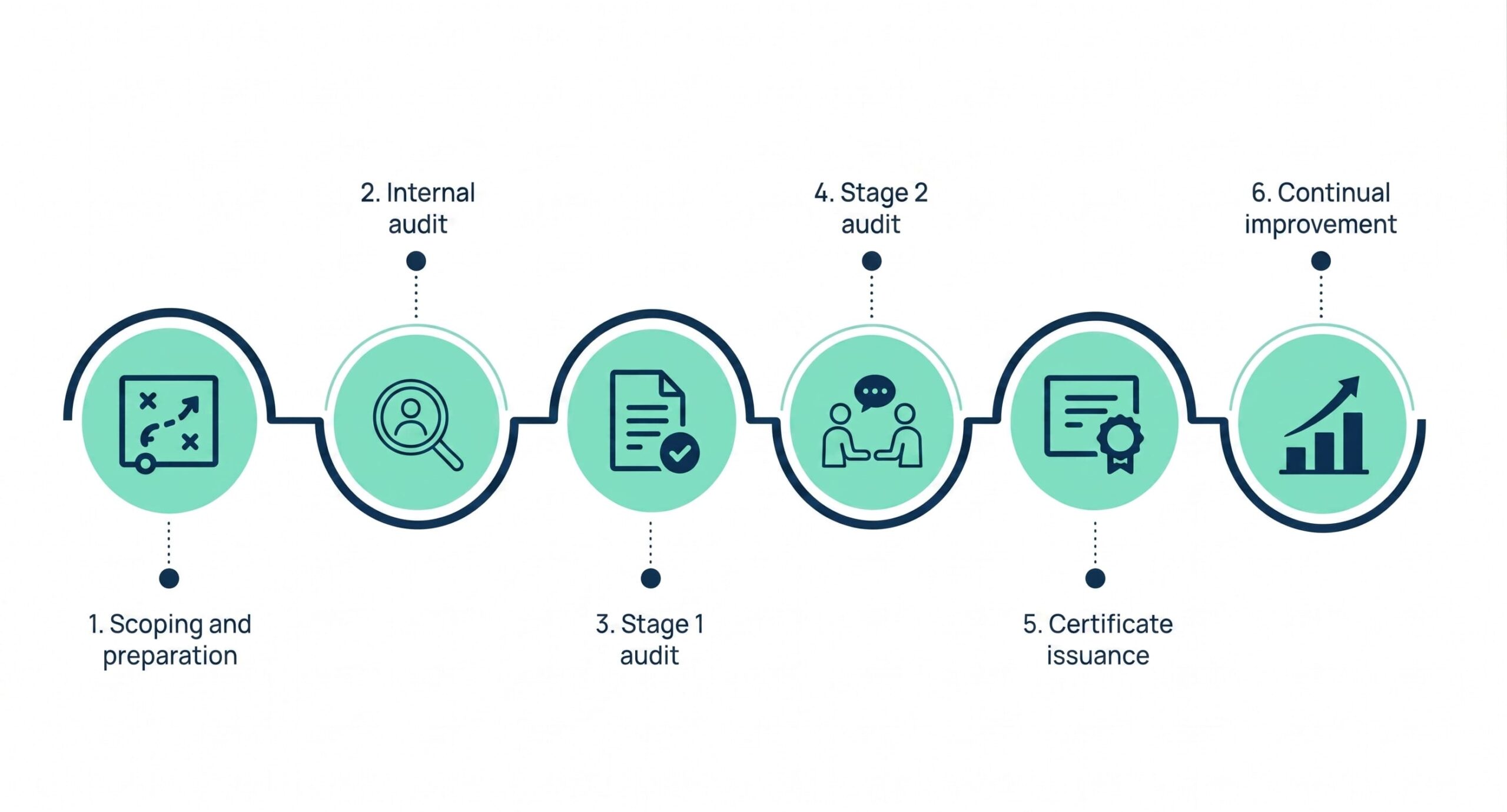
Most organisations follow six main steps on the way to an ISO 27001 certificate:
- Scoping and preparation: Define the scope of your ISMS and set the boundaries for the audit
- Internal audit: Review your processes before the external audit begins and close any gaps you can identify in advance
- Stage 1 audit: An external certification body reviews your documentation and checks whether your ISMS is ready for the next stage
- Stage 2 audit: Auditors look at how information security is handled in day-to-day work, for example through interviews, evidence checks and process reviews. SoSafe’s Human Risk Management Platform can support this stage by helping you document ongoing security awareness training and show how security culture is being built over time
- Certificate issuance: After a successful audit, you receive your official ISO 27001 certificate as formal recognition of your ISMS
- Continual improvement: Certification is not the finish line. Your ISMS needs to keep developing as your organisation, infrastructure and risks change
Ready for your next audit?
ISO 27001 requires demonstrable awareness. SoSafe helps you show it.
How long does ISO 27001 certification last?
ISO 27001 certification is valid for three years. But passing the first audit is not where the work ends. Most certification bodies return once a year for surveillance audits to check whether your ISMS is still being used, maintained and improved in practice.
That is the point of ISO 27001 accreditation: it is not a one-off task. Auditors will not be convinced by policies alone. They want to see how information security works in everyday decisions, routines and employee behaviour. Continuous cyber security awareness training helps keep secure habits present across the organisation. With human risk management, you can make this part of security culture easier to track and easier to evidence in future audits.
ISO 27001 certification cost: what to budget for
ISO 27001 certification has no standard price. Your budget depends on the scope of your ISMS, the processes you already have in place and the complexity of the environment being audited. Breaking down the main ISO 27001 cost factors early helps you budget with fewer unknowns.
Differences between SMEs and larger enterprises
For a smaller organisation with one location, a focused ISMS scope and a limited IT environment, the audit may take only a few days. For a larger enterprise with several locations, cloud environments and connected systems, the certification body will usually need much longer. Put simply, the more there is to assess, the more the project is likely to cost.
Audit fees, internal effort and consultancy
The ISO 27001 certification cost is not just the certification body’s invoice. The real budget usually comes together from several places:
- Smaller organisations may pay around €10,000 to €25,000 in first-year audit fees, depending on scope and provider
- Your teams need time to document processes, collect evidence and coordinate everyone involved
- External consultants can bring ISO 27001 experience, templates and structure when that expertise is not available in-house
- Preparation may reveal gaps in technology, documentation or controls that require additional investment
- Regular security awareness training helps show that people know how to handle information security in daily work
ISO 27001 certification requirements: what organisations need to prepare
Technical controls alone are not enough for an ISO 27001 audit. The ISO 27001 certification requirements also cover how information security is managed, who is accountable and how decisions are made. In practice, auditors look at two areas: management responsibility and the technical and organisational measures that protect information.
Management-level requirements
At management level, auditors want to see clear ownership of information security. That means defined roles, agreed objectives and active involvement from leadership in risk management. The ISMS also needs the right resources behind it, so information security is not just documented in policies but supported in day-to-day decisions.
Technical and organisational measures
At this level, the ISO 27001 requirements become concrete. Organisations define the controls they use to protect sensitive information, from access management to employee awareness. Annex A of ISO/IEC 27001 provides a detailed control set, but not every control applies to every organisation. What matters is whether the selected measures fit your risks, business context and ISMS scope.
ISO 27001 certification benefits: why organisations pursue certification
ISO 27001 certification often becomes relevant when customers, partners or public sector buyers ask for a recognised security standard. In regulated sectors, it may also support discussions around governance, controls and accountability. Even where ISO 27001 accreditation is not legally required, the certificate gives teams a clearer way to show how information security is managed.
For internal teams, the benefits are often very practical. A certified ISMS gives them documented answers for tenders, customer reviews and security questionnaires. That can reduce repeated work and make assurance conversations more straightforward. ISO 27001 certification also helps organisations connect security controls with related compliance topics such as GDPR, NIS2 or DORA. Audit readiness is not only about technology. Auditors also look at whether employees understand their role in protecting information. SoSafe’s Human Risk Management Platform helps teams document awareness activities and show how security culture develops over time. Book a demo to see how SoSafe can support your audit readiness.
Scale your security
culture with ease















 Reports
  Guides
  Blog
Blog  Glossary
  Perks
Perks  Customer stories
  Webinars
  Replays
  Podcast
  All events
  Signal Security Summit
  Danger Lab
 Careers
  News & press
  Contact