Use training based on NIST, ISO/IEC 27001, CIS Controls and more to make security part of everyday work.
IT Leadership Support, Gestión del riesgo humano
Enterprise security frameworks: a guide to security architecture
Enterprise security frameworks bring structure to cyber security. They align risk, controls and ownership across teams and support a consistent security architecture.
Contents
- Enterprise security frameworks compared
- ISO 27001
- NIST Cybersecurity Framework
- CIS Controls
- TOGAF framework
- Zachman framework
- SABSA framework
- COBIT framework
- MITRE ATT&CK
Key takeaways: enterprise security frameworks
- Enterprise security frameworks create consistency and strategic direction
- Frameworks differ in purpose, level of detail and implementation effort
- ISO 27001, NIST CSF, CIS Controls, COBIT, SABSA, TOGAF, Zachman and MITRE ATT&CK are key reference points
- The matrix helps organisations choose the right framework based on their risks and requirements
- Combining multiple frameworks is common practice
- SoSafe supports human risk management with a focus on leading cyber security frameworks
Frameworks as the foundation of enterprise security architecture
An enterprise security architecture provides the structured frame that turns isolated measures into a coherent security culture. Enterprise security frameworks create clarity, define responsibilities and anchor security as part of the overall business strategy. With the right enterprise security frameworks in place, CISOs keep sight of complex IT landscapes and help ensure that technical and organisational controls work together rather than in isolation.
Challenges without a unified framework
Without clear enterprise security frameworks, security activities often remain fragmented. Each department follows its own approach, and gaps open up between these islands that attackers can exploit. On top of this, business and IT do not always share the same assumptions, which slows down decisions and makes implementation harder. At the same time, regulatory and compliance requirements keep growing and call for a consistent approach that is much easier to establish and maintain when robust enterprise security frameworks are already in place.
Comparison criteria for enterprise security frameworks
Choosing a framework is a central step when you design a consistent enterprise security architecture. The available enterprise security frameworks differ in what they are meant to achieve, how deep they go and how much effort they require. A structured comparison helps you see where each framework is strong, where its limits are and which enterprise security frameworks fit your strategy, daily operations and regulatory pressure. When you look at the main cyber security frameworks, a few criteria are particularly useful.
Important criteria include:
- Purpose and scope: Some enterprise security frameworks focus on management systems, for example COBIT and ISO 27001, while others provide concrete control catalogues such as CIS Controls.
- Level of detail: SABSA vs TOGAF is a good example of two very different styles. SABSA starts from risk and business goals, whereas TOGAF concentrates on the structure of the IT landscape.
- Implementation effort: TOGAF usually means high complexity and a noticeable demand on time and resources. CIS Controls are slimmer and can often be rolled out step by step with less upfront effort.
- Compliance relevance: If you compare COBIT vs NIST, both give orientation as governance frameworks, while ISO 27001 also supports formal certification and external proof of your ISMS.
- Currency: TOGAF and COBIT both go back to the 1990s, but have been revised several times and are still used in current architecture and governance work.
- Compatibility: Enterprise security frameworks are rarely used in isolation. TOGAF can provide the architectural frame, with governance models or risk frameworks on top. A look at TOGAF and Zachman shows how differently architecture methods can link IT and the business side.
The comparison table below brings these criteria together for the main enterprise security frameworks. It gives you a quick sense of which frameworks fit which priorities and how they can support a broader enterprise security architecture.
Comparison table of the most important frameworks
| Framework | Purpose / Scope | Level of detail | Effort | Compliance reference | Compatibility | Current relevance |
| ISO 27001 | ISMS, compliance | Medium | ⚙️⚙️ | Certifiable ISMS standard; often mapped to regulatory requirements | 🔗🔗🔗 | 2005 → 2022 (current version) |
| NIST Cybersecurity Framework | Governance, risk management | High | ⚙️⚙️ | Orientation; not certifiable; frequent mappings | 🔗🔗🔗 | 2014 → 2024 (2.0) |
| CIS Controls | Prioritised safeguards | High | ⚙️–⚙️⚙️ | Not certifiable; often used as a control layer | 🔗🔗 | 2008 → 2021 (v8) |
| TOGAF | Enterprise architecture | High | ⚙️⚙️⚙️ | indirect (ADM/governance integration) | 🔗🔗 | 1995 → 2022 (10th Edition) |
| Zachman framework | Architecture metamodel | Medium | ⚙️⚙️ | no compliance framework | 🔗 | 1987 (taxonomy maintained) |
| SABSA | Risk and security architecture | High | ⚙️⚙️⚙️ | framework compatible; no certificate reference | 🔗🔗🔗 | since 1995 (further developed) |
| COBIT framework | IT governance and management | Medium | ⚙️⚙️ | Governance/audit connections; not certifiable | 🔗🔗🔗 | 1996 → 2019 (COBIT 2019) |
| MITRE ATT&CK | Threat intelligence and TTPs | High | ⚙️ | supplementary; no compliance framework | 🔗🔗🔗 | 2013 → continuously updated |
Test our human risk platform

Book a demo
ISO 27001
The ISO 27001 framework is the best‑known standard for information security management systems (ISMS) and a frequent anchor for enterprise security frameworks. It covers both technical and organisational controls and gives companies a clear model for running and improving an ISMS. One practical benefit: organisations can have their ISMS certified against ISO 27001 and use this as external evidence when they explain their enterprise security architecture to customers, partners or regulators. The 2022 update addresses current threats and can be mapped to requirements such as NIS2 and DORA, which is why ISO 27001 is particularly common in regulated environments.
Video: practical insights into ISO 27001
In this video, Jörg Buss, one of the early ISO 27001 experts in Germany, talks about how information security has developed over time and how organisations can prepare for new rules such as NIS2.

NIST CSF
The NIST Cybersecurity Framework (NIST CSF) structures security work into core functions: Identify, Protect, Detect, Respond and Recover. With version 2.0, NIST added a separate Govern function so that roles, ownership and decision‑making are more visible. The new version also looks more closely at supply‑chain risks and at how outcomes can be measured in practice. NIST CSF is not a certification standard, but it is often used as a reference and mapped to regulatory requirements, and many enterprise security frameworks use it as their governance layer. Alongside the framework, NIST SP 800‑207 describes zero trust architecture as an alternative to classic perimeter‑based models.
CIS Controls
The CIS Controls are a practical catalogue of concrete measures against common cyber attacks. Unlike broader enterprise security frameworks such as NIST CSF or ISO 27001, the CIS framework groups individual safeguards that are clearly prioritised and testable. They range from basic tasks like asset inventory and secure configuration to more advanced processes such as incident response. Version 8, released in 2021, defines 18 controls and organises them into Implementation Groups (IG1 to IG3), allowing organisations to scale adoption by risk and size. Within an enterprise security architecture, CIS Controls offer a way to improve the security baseline quickly and in a measurable way.
TOGAF framework
The TOGAF framework is a widely used model for enterprise architecture. It defines methods and processes for aligning business processes, applications, data and technology. Security is not its primary focus, but it can be integrated into the Architecture Development Method (ADM), for example in the Architecture Vision phase or via dedicated security architecture viewpoints. For enterprise security frameworks, this means TOGAF provides the structure in which security can be built in from the start. TOGAF is not designed as a stand‑alone security framework, so in practice it is often combined with specialised enterprise security frameworks such as SABSA or COBIT.
Zachman framework
The Zachman framework is one of the earliest approaches to enterprise architecture and is often described as a metamodel. It organises complex organisations around six questions – what, how, where, who, when and why – and maps them across layers such as planning, business models and technology. For enterprise security frameworks, Zachman does not provide its own control set, but a matrix that shows where security topics can be anchored across the architecture. It is therefore mainly used as a structuring tool that works alongside dedicated security frameworks.
SABSA framework
The SABSA framework (Sherwood Applied Business Security Architecture) follows a consistently risk‑driven approach. It derives security requirements from business objectives and carries them through several layers, from the contextual layer down to the component layer. This links business risk with security design and day‑to‑day operations. In an enterprise security architecture, SABSA makes it possible to tie security measures closely to business value. In practice, SABSA is often combined with other enterprise security frameworks such as ISO 27001 or COBIT to cover governance and compliance aspects as well.
COBIT framework
The COBIT framework is an established standard for IT governance and management. It defines governance objectives, processes and metrics that help organisations assess the contribution of IT and keep risks under control. Security requirements can be aligned with business goals, management oversight and internal control systems. Unlike ISO 27001, COBIT itself is not certifiable, but it is widely used in governance and audit contexts and often appears in enterprise security frameworks that need a strong steering layer. It is particularly effective when combined with ISO 27001 or NIST CSF.
MITRE ATT&CK matrix
The MITRE ATT&CK matrix is an open catalogue of attacker tactics, techniques and procedures (TTPs) based on real observations. It is updated on a regular basis so that new attack methods are reflected quickly. In contrast to most enterprise security frameworks, MITRE ATT&CK does not define policies or governance structures. Instead, it gives security teams a practical view of how attacks unfold in the real world. In an enterprise security architecture, MITRE ATT&CK is mainly used for threat modelling, red teaming and for developing or refining detection and response use cases. Many organisations also use it in purple‑team exercises to check whether their defences hold up against likely attack paths.
Video: MITRE ATT&CK in the context of cloud and chaos engineering
In this video, Kennedy Tokura explains how organisations can use security chaos engineering to strengthen their security architecture and how the MITRE ATT&CK matrix supports this work.

Other security frameworks at a glance
Beyond the established models, there are frameworks that address specific needs or sectors. Used in the right place, they complement enterprise security frameworks and add guidance in more specialised contexts.
CIS framework
The CIS framework adds an organisational layer around the CIS Controls. It gives organisations a structure to plan, track and review their prioritised measures and to tie them into overall security management. For teams already working with CIS Controls inside their enterprise security frameworks, the CIS framework mainly adds orientation and governance.
Essential Eight framework
The Essential Eight framework from the Australian Cyber Security Centre defines eight basic controls, including patching, multi‑factor authentication and regular backups. The idea is deliberately pragmatic: especially mid‑sized organisations and public bodies can use this essential 8 framework to improve cyber resilience quickly, without first setting up a large governance programme.
DoDAF framework
The DoDAF framework (Department of Defense Architecture Framework) is mainly used in the US defence sector. It helps model complex systems from an architectural point of view and makes security‑relevant dependencies more visible. For enterprise security frameworks in civilian organisations, DoDAF is rarely the first choice, but it can provide useful methods for architecture work in highly complex, tightly governed environments.
FEAF framework
The FEAF framework (Federal Enterprise Architecture Framework) is used in the US federal administration to steer public IT systems. It is meant to make investments more transparent and to bring security risks into view early in the planning process. For companies outside the public sector, the feaf framework usually plays only a minor role, but its governance logic can still inform enterprise security frameworks in heavily regulated environments.
Which cyber security framework is right for your enterprise?
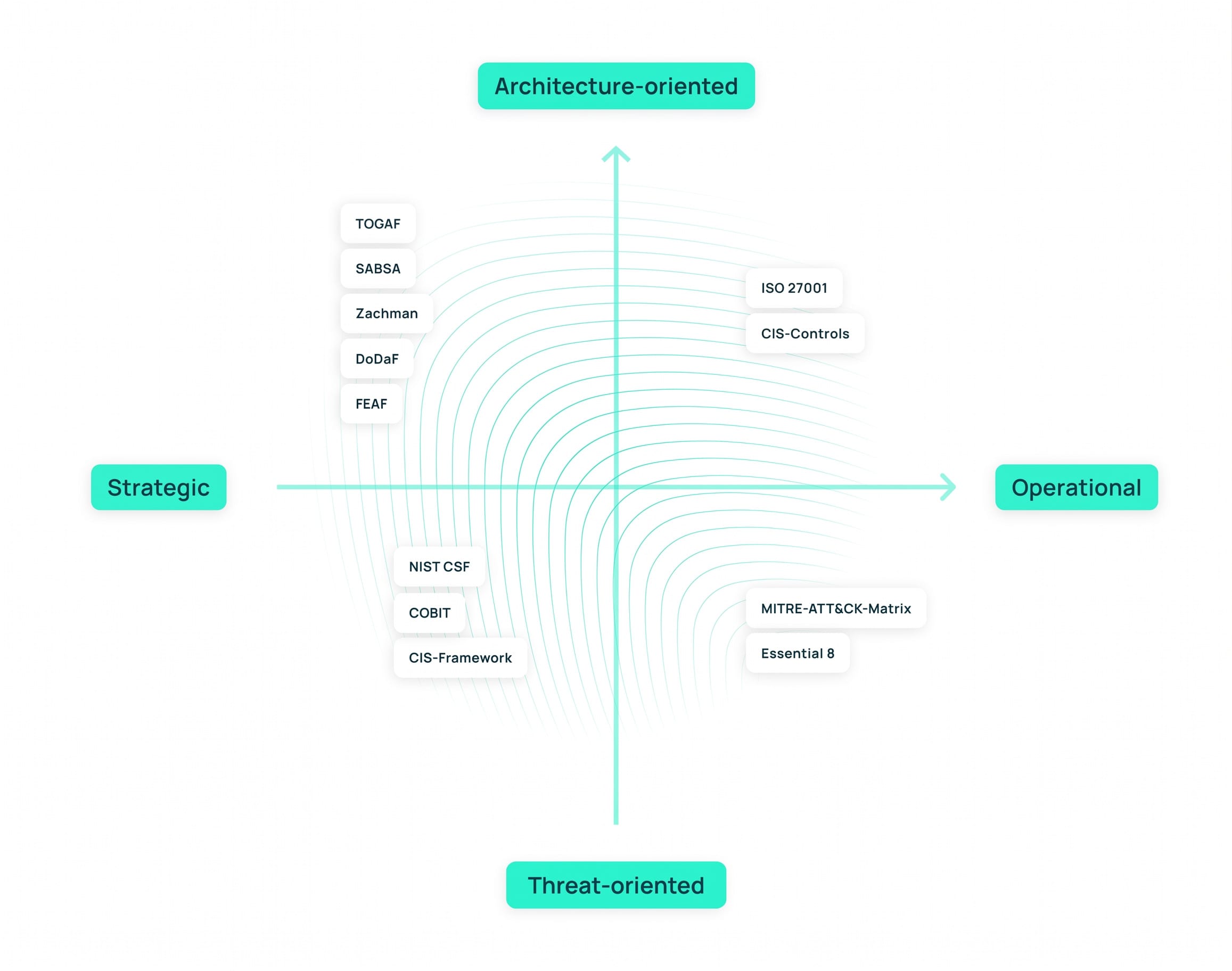
Choosing the right framework depends heavily on your organisation’s goals, resources and maturity level. The following matrix maps the most important enterprise security frameworks across two dimensions and shows how they support your enterprise security architecture and day‑to‑day security work.
Master security frameworks

Book a demo
Use training based on NIST, ISO/IEC 27001, CIS Controls and more to make security part of everyday work.
The matrix shows how enterprise security frameworks differ across two core dimensions.
- Strategic vs operational: Do they primarily provide structure and governance, or do they define concrete measures that teams can implement and test?
- Architecture‑oriented vs threat‑oriented: Is the focus on business and IT architecture, or on defending against real‑world attacks?
- Strategic and architecture‑oriented: TOGAF, the Zachman framework, SABSA, DoDAF and FEAF provide organising structures for enterprise and security architectures. They help position security in the wider enterprise security architecture and connect it to business capabilities.
- Strategic and threat‑oriented: NIST CSF, COBIT and the CIS framework address governance, risk management and compliance. In many enterprise security frameworks, they form the steering layer on top of more detailed cyber security frameworks and control sets.
- Operational and architecture‑oriented: ISO 27001 and CIS Controls define concrete measures that can be embedded into security architectures and audited over time. They give enterprise security frameworks a tangible control base that can be tracked and improved.
- Operational and threat‑oriented: The MITRE ATT&CK matrix and the Essential Eight framework focus on real attack techniques and defensive priorities. They show how well an enterprise security architecture holds up against realistic threats and where additional hardening is needed.
Recommendations for different organisations
- Mid‑sized organisations
CIS Controls or the Essential Eight framework help raise the security baseline without a large project in front. Both can be built into enterprise security frameworks where quick, noticeable improvements are the first goal. - International enterprises
Often combine ISO 27001 for certification and audits with NIST CSF for governance and risk management. Together, this gives enterprise security frameworks an ISMS anchor and a clear frame for steering enterprise security architecture across regions. - Highly regulated sectors
Often combine COBIT and ISO 27001 and add architecture‑oriented models such as the FEAF or DoDAF framework. In these environments, enterprise security frameworks have to support clear governance, audits and documented controls. Purely technical hardening is not enough. - Organisations with high threat exposure
Often use the MITRE ATT&CK matrix to analyse concrete attack techniques and patterns. Together with CIS Controls, this turns attacker behaviour into targeted protective measures that can be anchored in the existing enterprise security architecture. - Architecture‑driven organisations
Tend to start with TOGAF, the Zachman framework or SABSA and then add governance frameworks and operational control catalogues. In these setups, enterprise security frameworks are closely tied to enterprise security architecture and help connect business goals, risk and implementation work.
Do you want to stay ahead of the cyber game?
Sign up for our newsletter to receive the latest cyber security articles, events, and resources. No spam, only content that truly matters.

















 Reports
  Guides
  Blog
Blog  Glossary
  Perks
Perks  Customer stories
  Newsletter signup
  Webinars
  Replays
  Podcast
  All events
  Signal Security Summit
  Danger Lab
 Why SoSafe
  Careers
  News & press
  Contact