Navigation:
Adaptive defence learns continuously from real-world threats, human behaviour, and organisational context – enabling a resilient security culture as risks evolve.”
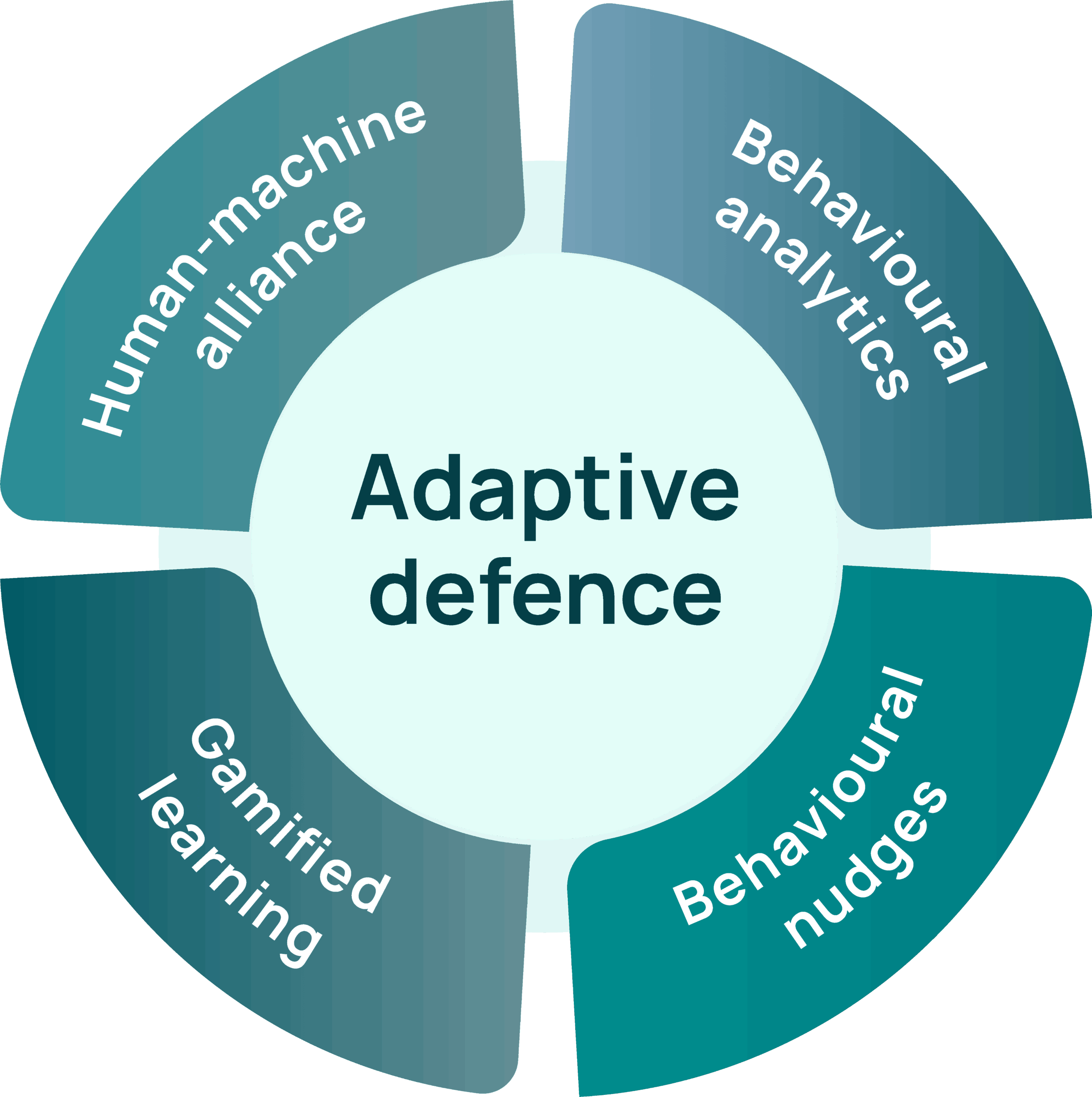
Technically speaking, adaptive defence is about accelerating behavioural change across evolving threat environments. In practice, this system continuously learns from real-world threats, human behaviour and organisational context to enable a resilient security culture against evolving risks. It reaches beyond the traditional static security framework by prioritising prediction and prevention over detection and remediation.

Moving from signal overload to a “signal-to-shield” model. This reduces the time from threat detection to behavioural reinforcement.
Moving from static compliance to personalised reinforcement. This ensures role-relevant encoding depth—the right person gets the right learning at the right time.
Moving from isolated awareness to connected intelligence. This uses the Human Security Index (HSI) to aggregate signals across awareness, exposure, and response.


Stop scheduling annual or compliance-driven content. Instead, recalibrate behaviour based on evolving internal and external threat signals.
Align learning paths to specific roles, risk exposure, and regulatory responsibilities rather than one-size-fits-all modules.
Use our online test environment to see how our platform can help you empower your team to continuously avert cyber threats and keep your organization secure.

This page is not available in English yet.
Diese Seite ist noch nicht in Ihrer Sprache verfügbar. Sie können auf Englisch fortfahren oder zur deutschen Startseite zurückkehren.
Cette page n’est pas encore disponible dans votre langue. Vous pouvez continuer en anglais ou revenir à la page d’accueil en français.
Deze pagina is nog niet beschikbaar in uw taal. U kunt doorgaan in het Engels of terugkeren naar de Nederlandse startpagina.
Esta página aún no está disponible en español. Puedes continuar en inglés o volver a la página de inicio en español.
Questa pagina non è ancora disponibile nella tua lingua. Puoi continuare in inglese oppure tornare alla home page in italiano.