FOR PHARMA, LIFE SCIENCES AND MEDICAL DEVICE MANUFACTURERS
Pharmaceutical cyber security for the people who protect your research and production
- Security awareness training and phishing simulations for pharmaceutical companies
- Learning paths by department for labs, clinical teams, GMP production, quality and field teams
- A programme aligned with NIS2 and ISO/IEC 27001 that runs alongside mandatory GxP training
How SoSafe helps
Solutions for your pharmaceutical cyber security risks
Training that fits beside the GxP curriculum
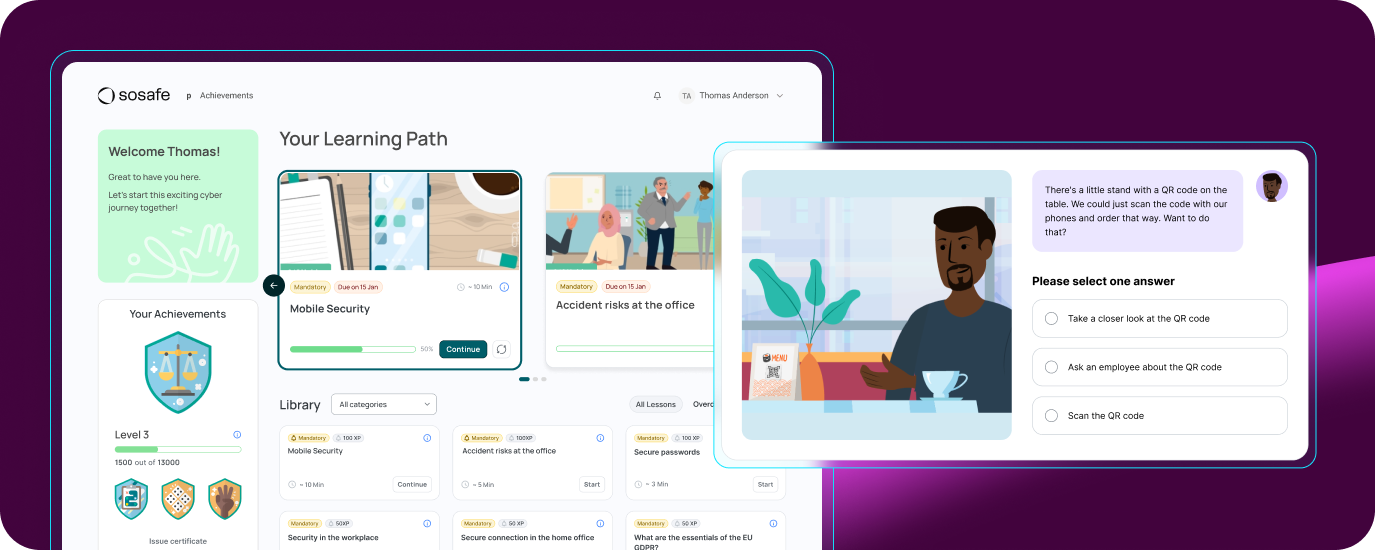
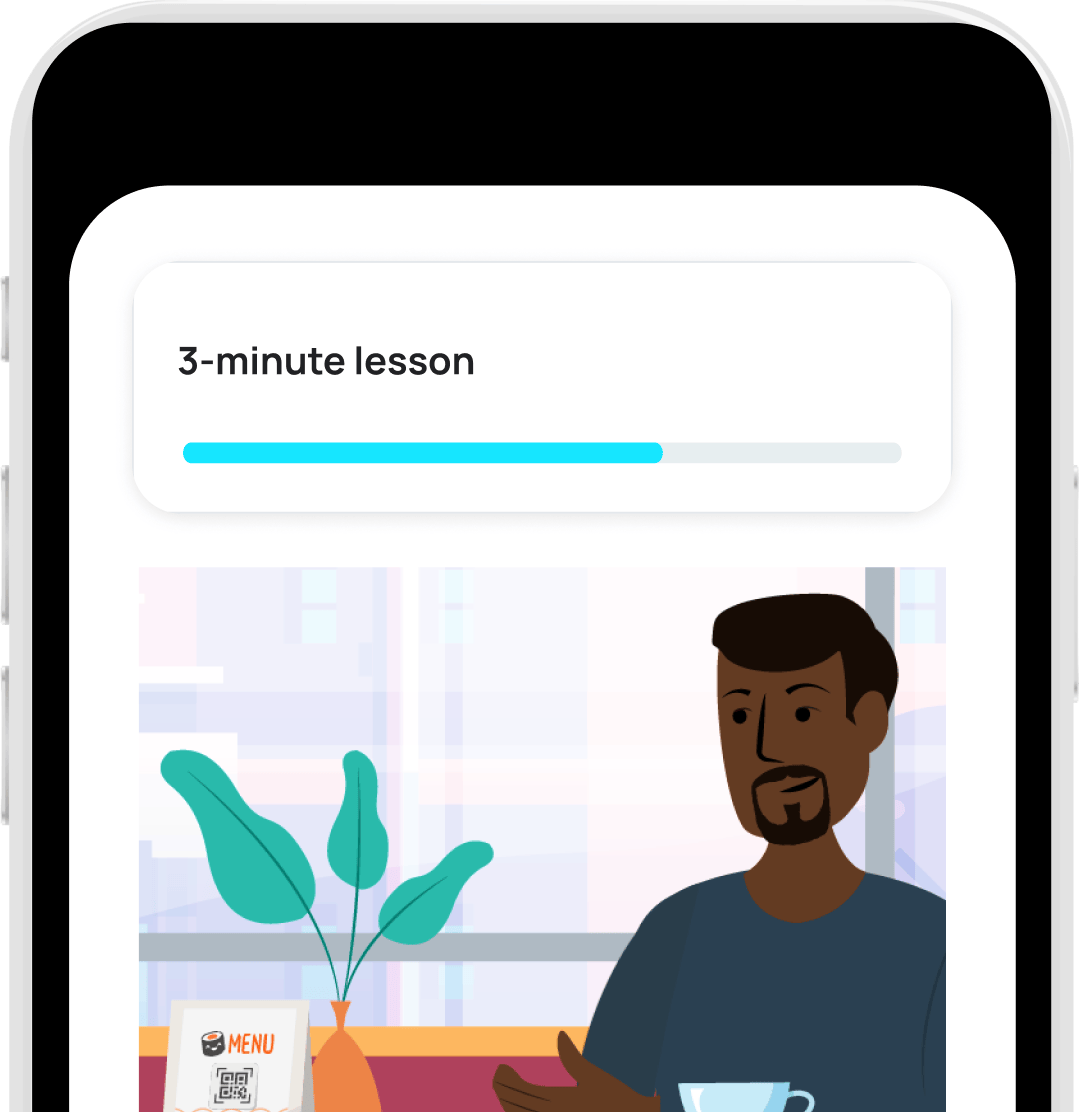
Cyber security in the pharmaceutical industry has to fit into a training calendar that is already full. Research, quality and production staff complete a long list of mandatory GxP and pharmacovigilance courses. SoSafe runs alongside them as a complementary programme. Lessons take one to eight minutes and build secure habits without taking over the training calendar.
Simulations that look like regulated work
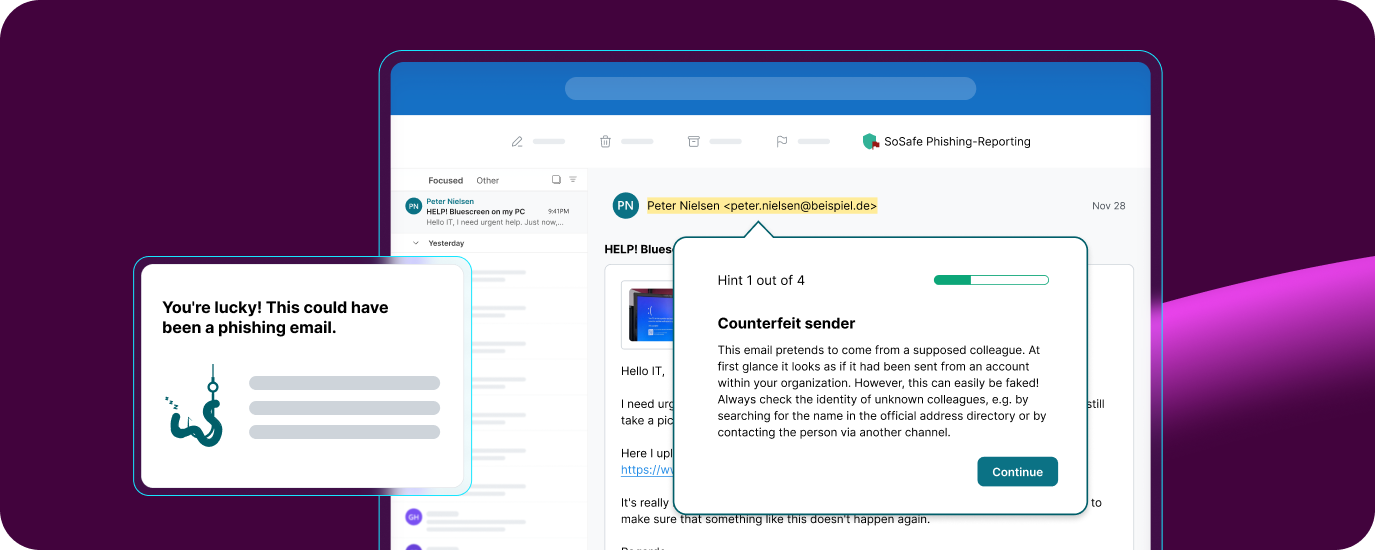
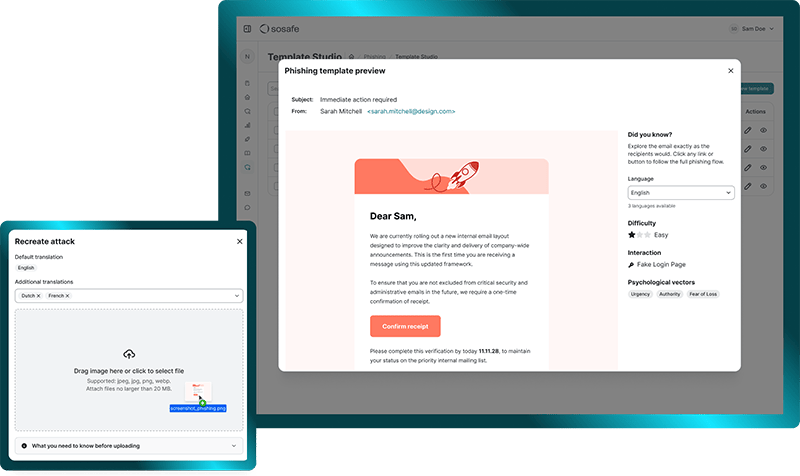
Create or customise phishing simulations around lures like this, such as a supposed file from a trial site or a supplier’s certificate of analysis. Email simulations adjust difficulty and cadence to each person’s performance and risk, and SMS simulations train field staff to spot smishing.
Behaviour you can measure
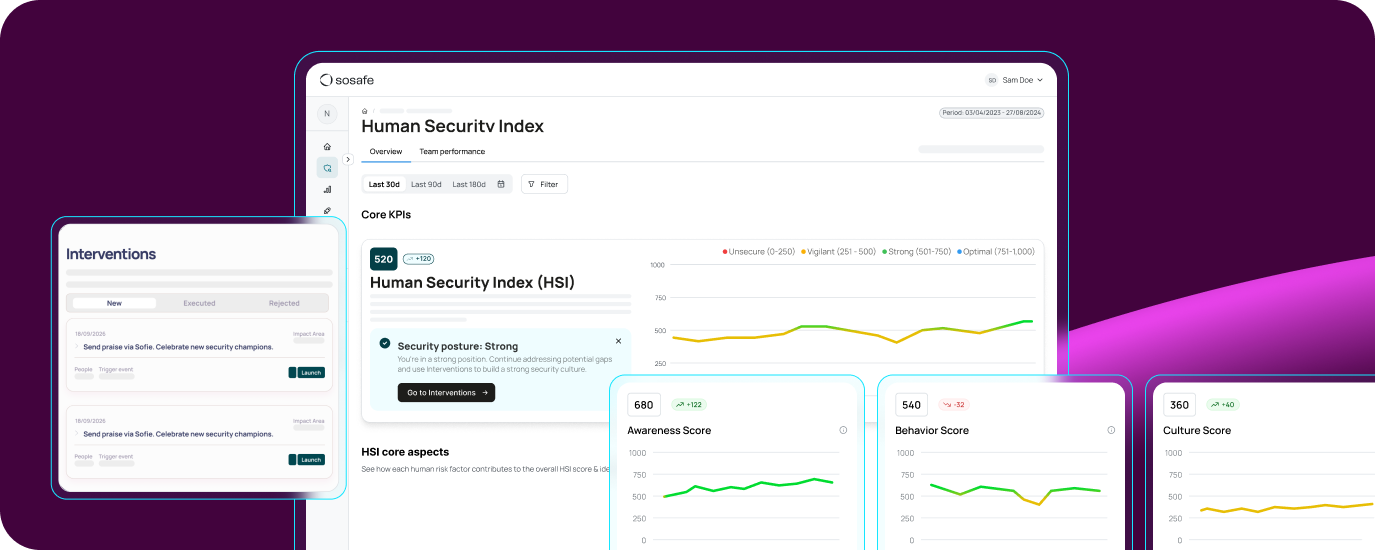
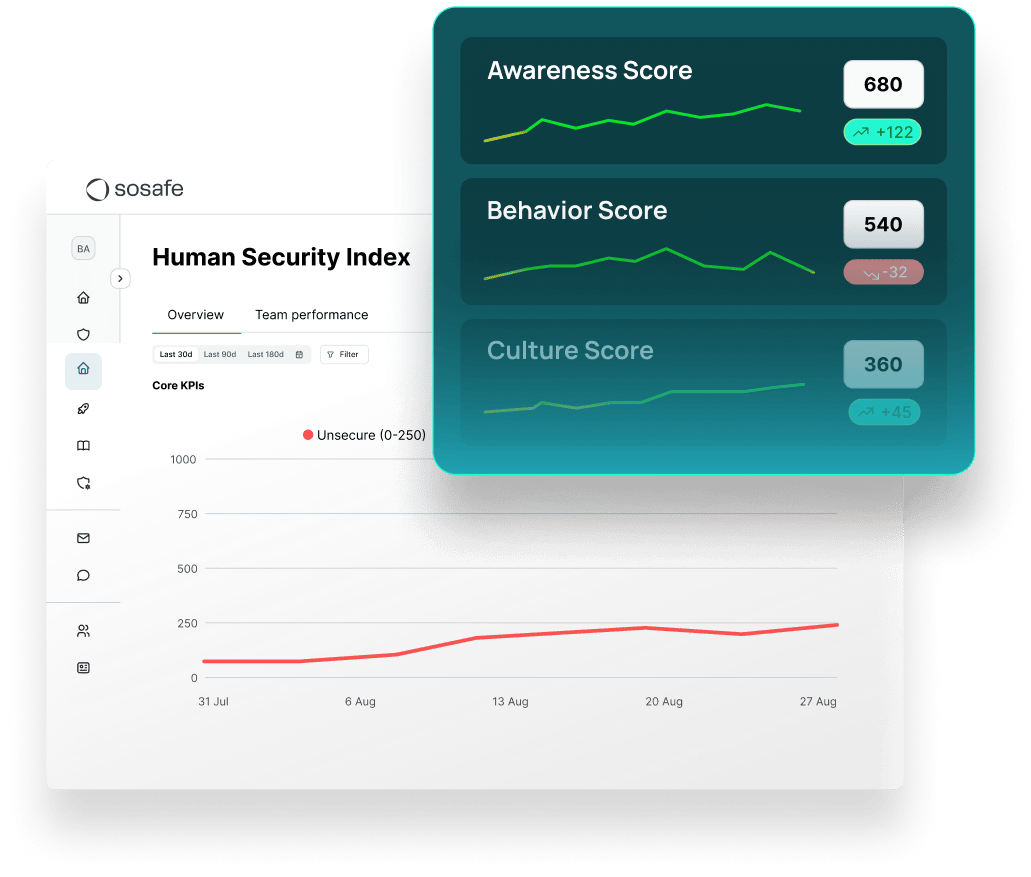
A completion rate says little about whether someone would report a suspicious email tomorrow. For pharmaceutical cyber security, the Human Security Index looks at what people actually do. It combines simulation responses, reported threats and learning progress into one figure that quality, security and management can follow over the year.
Training that fits beside the GxP curriculum
Cyber security in the pharmaceutical industry has to fit into a training calendar that is already full. Research, quality and production staff complete a long list of mandatory GxP and pharmacovigilance courses. SoSafe runs alongside them as a complementary programme. Lessons take one to eight minutes and build secure habits without taking over the training calendar.
Simulations that look like regulated work
Create or customise phishing simulations around lures like this, such as a supposed file from a trial site or a supplier’s certificate of analysis. Email simulations adjust difficulty and cadence to each person’s performance and risk, and SMS simulations train field staff to spot smishing.
Behaviour you can measure
A completion rate says little about whether someone would report a suspicious email tomorrow. For pharmaceutical cyber security, the Human Security Index looks at what people actually do. It combines simulation responses, reported threats and learning progress into one figure that quality, security and management can follow over the year.
THE CHALLENGE
Where attacks on pharma and med devices companies usually begin

Research and regulatory data
In its analysis of incidents in the EU during 2025, ENISA describes a health sector threat picture shaped mainly by unauthorised access, and ransomware accounted for 26.8% of the financially motivated attacks (ENISA Threat Landscape 2026, September 2026). For a pharmaceutical company, unpublished trial results, formulations and correspondence with regulators are what such attackers are after. In June 2026, Novo Nordisk reported unauthorised access to a limited number of internal IT systems. Pseudonymised data from clinical trial participants, including health and biomarker data, was copied externally (Novo Nordisk, June 2026).

Messages that follow the regulatory calendar
Pharma teams open messages from outside the company every day: questions from authorities, documents from clinical sites and research partners, audit announcements, certificates from suppliers. Attackers copy exactly these formats because nobody can afford to ignore them. Phishing written with AI tools makes the copies harder to tell apart from the real thing.

Records that must stay trustworthy
In GMP manufacturing and in the laboratory, systems record who did what and when. An attacker who logs in with stolen credentials does more than steal data. Entries lose their reliability, and a batch release can stall until it is clear what happened. This is where pharmaceutical cyber security meets data integrity.
Confidential data in AI tools and phone calls
Study data or a formulation pasted into a public AI tool leaves the company’s control. A familiar-sounding voice on the phone asking for an urgent approval can be generated with voice cloning. Both risks start with a routine decision that someone makes in a few seconds.
COMPLIANCE AND AUDIT-READINESS
What NIS2, GMP and ISO/IEC 27001 expect from people
Regulators now ask whether pharmaceutical cyber security training works. NIS2 ranks drug and critical medical device manufacturers as highly critical, and the draft EU GMP Annex 11 proposes testing its effect, for example by simulation. SoSafe helps you demonstrate that effect, aligned with NIS2 and ISO/IEC 27001.


WHO GETS TRAINED
Role-based training for pharma cyber security
Research and laboratory teams
Scientists and lab staff handle unpublished results and exchange data with partners around the world. Simulations can imitate lures from supposed collaborators or file shares from unknown senders, and lessons on generative AI cover what may go into an AI tool. Staff at shared lab workstations can join without a company email address.
Clinical and pharmacovigilance teams
Clinical operations and pharmacovigilance teams have to open messages from sites, patients and healthcare professionals, often with attachments. Training helps them check a link or an attachment quickly, so that security does not get in the way of time-critical reporting.
On the production floor and in quality assurance
Build a learning path for production and quality that pairs security lessons with your own procedures. Shift operators without a company email can still enrol. Lessons explain two-factor authentication without jargon, including what to do about a login prompt nobody requested.
In the field, in management and in IT
Sales reps and medical science liaisons often read messages on their phones in the car park before the next appointment. Smishing simulations meet them there. Managers receive a shorter track built around their own responsibility for cyber risk, while IT staff with privileged access go deeper.
Lessons in a few minutes
Lessons adapt to role, prior knowledge and risk profile. Assign one path to the lab and another to sales, each in units of one to eight minutes on a desktop or a phone.
From reported email to simulation
When a phishing email reaches your organisation, such as a fake request from an authority, the security team can rebuild it as a simulation in a few minutes and send it to the people it targeted.
A practice call in the browser
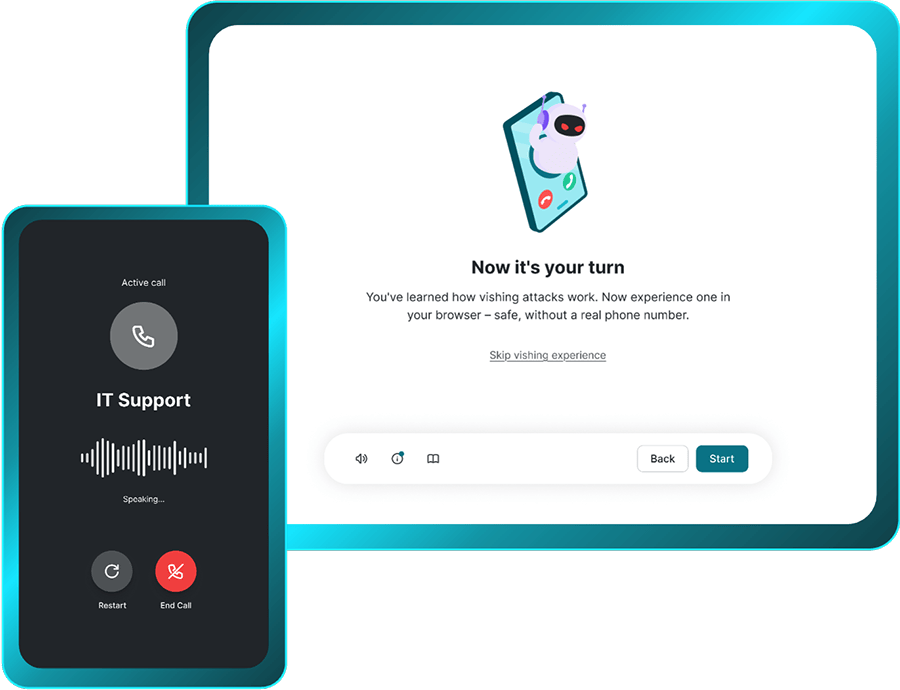
The Interactive Vishing Lesson ends with a realistic call in the browser, such as a caller from “IT support” who asks for a login code. No phone numbers are needed. It builds the habit of checking but records no failure rate.
One click to report
The report button sits in the email client. One click sends a suspicious message to a single triage queue, where the security team reviews all reports together and decides what needs action.
Your own rules as lessons
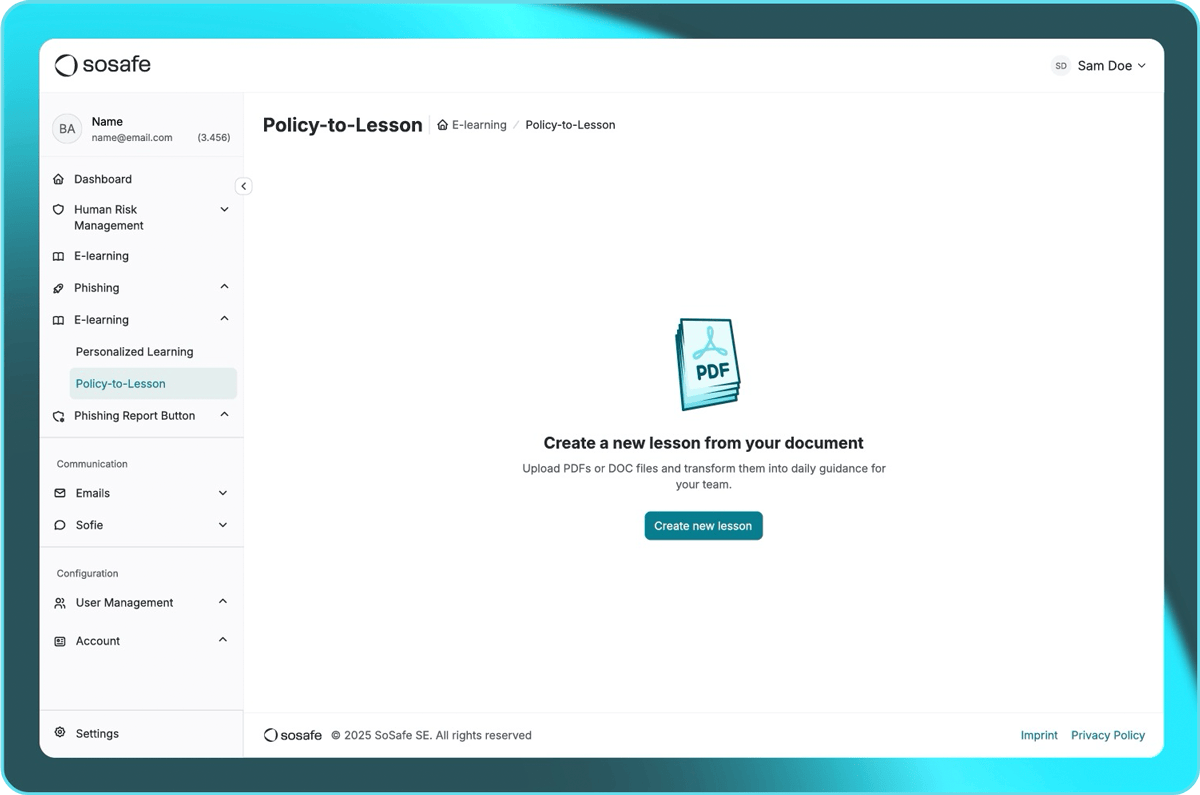
Upload an SOP as a PDF, such as your rule for AI tools and study data. Policy-to-Lesson drafts an editable lesson for your team to review before publishing, in languages enabled in your account.
Evidence for audits and management
NIS2, ISO/IEC 27001 and GDPR reports come from the same data as the Human Security Index, which shows how behaviour develops across teams.
88%
knowledge retention after 12 months
90%
reduction in risky interactions
80%
reporting threats within 12 months
15 min
per week to run the full programme

Measurable impact for pharma and medtech teams
For pharmaceutical cyber security, quality and security teams need evidence that behaviour changes, not only that training took place. SoSafe is trusted by more than 6,000 organisations worldwide, and the figures below come from aggregated data across their live programmes in all sectors.
Connected to the systems pharmaceutical companies already run
Cybersecurity in life sciences runs on many connected systems. SoSafe connects with your identity provider, your HR system for user provisioning and the collaboration tools your teams work in. If your GxP training records sit in your own learning management system, lessons can be exported there as SCORM packages.
Integrations
See all the integrations




Compliance
See all our certificationsGDPR Compliant
German Engineered
EU Hosted
Pharmaceutical cyber security FAQs
See SoSafe at work in pharma and medtech










 Reports
 Guides
 Blog
 Glossary
 Perks
 Customer stories
 Webinars
 Replays
 Podcast
 All events
 Signal Security Summit
 Danger Lab
 Careers
 News & press
 Contact
