FOR ENERGY, WATER AND UTILITIES COMPANIES
Utilities cyber security for the people who keep supply running
- Security awareness training and phishing simulations for companies within the energy, water and utilities sector
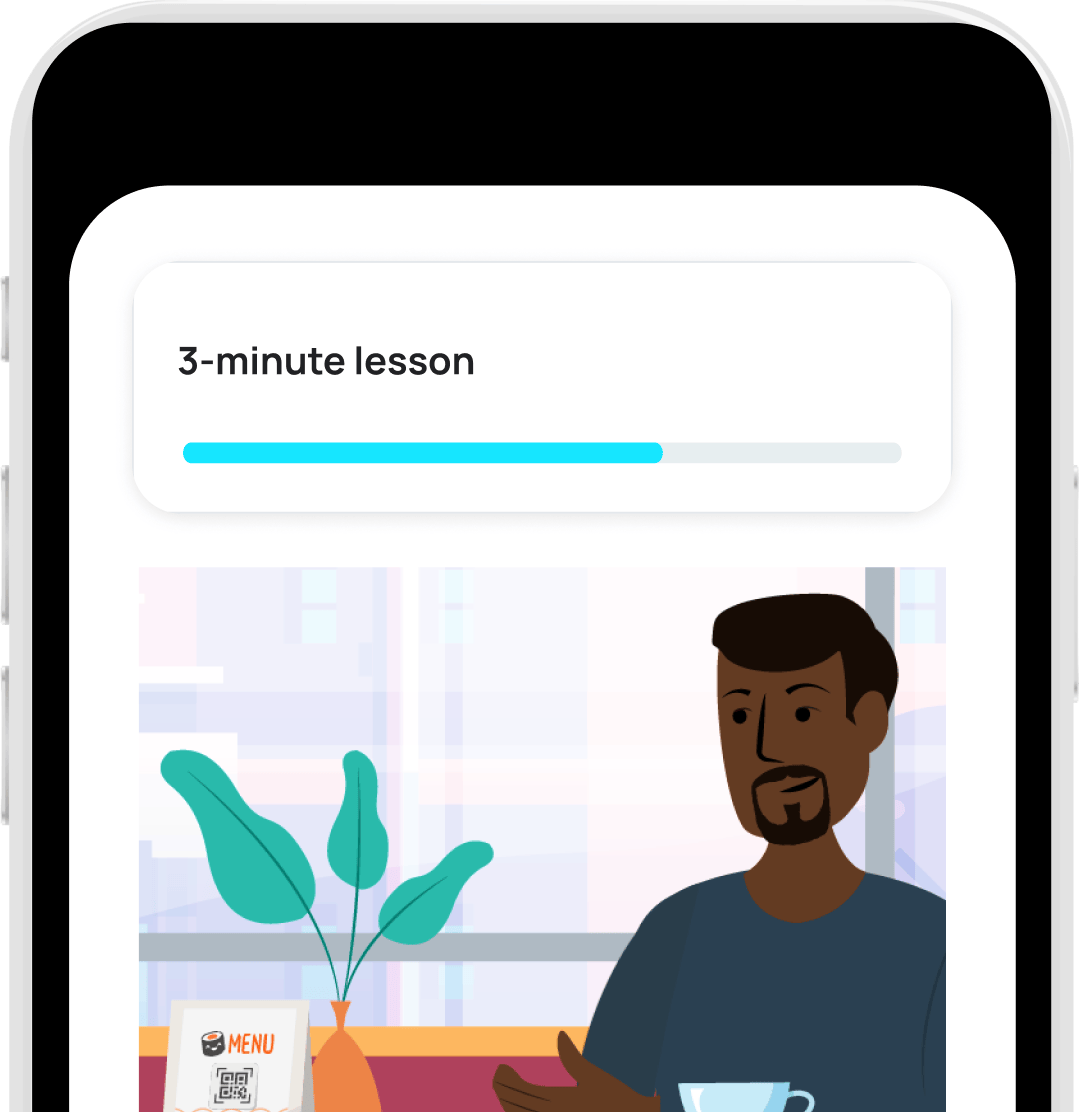
- Lessons of one to eight minutes for control rooms and field crews, no company email needed
- Audit reports aligned with NIS2, ISO/IEC 27001 and GDPR that show behaviour change over time
How SoSafe helps
Solutions for your utilities cyber security risks
Training that fits between shifts and call-outs
Whether someone works at a shared console in the control room or checks a phone in the service van, they get short lessons on the device they already use. Enrolment works without a company email address, so utilities cyber security reaches the teams who keep power and water flowing, not only the office.
Simulations that look like a normal working day
An invoice from a maintenance contractor you really do work with looks just like the ones that arrive every week. Phishing simulations by email and SMS build on everyday situations like this. In email simulations, difficulty and frequency adjust to each person’s results: people who spot the fakes move on to harder scenarios, while those who struggle get foundational guidance.
Reporting that shows behaviour change, not just attendance
Completion rates alone say little about risk. SoSafe turns simulation results, reported threats and learning progress into reports that map to NIS2, ISO/IEC 27001 and GDPR. Management can follow human risk trends in the Human Security Index, a score built from awareness, behaviour and culture data, while the security team sees which departments need attention.
Training that fits between shifts and call-outs
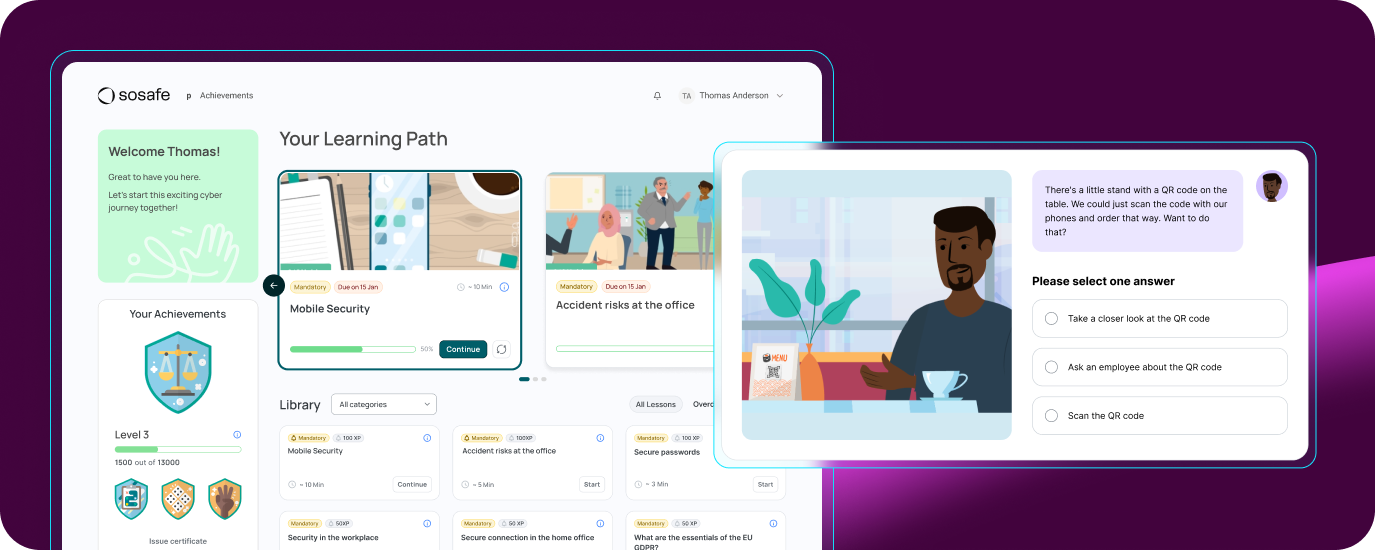
Whether someone works at a shared console in the control room or checks a phone in the service van, they get short lessons on the device they already use. Enrolment works without a company email address, so utilities cyber security reaches the teams who keep power and water flowing, not only the office.
Simulations that look like a normal working day
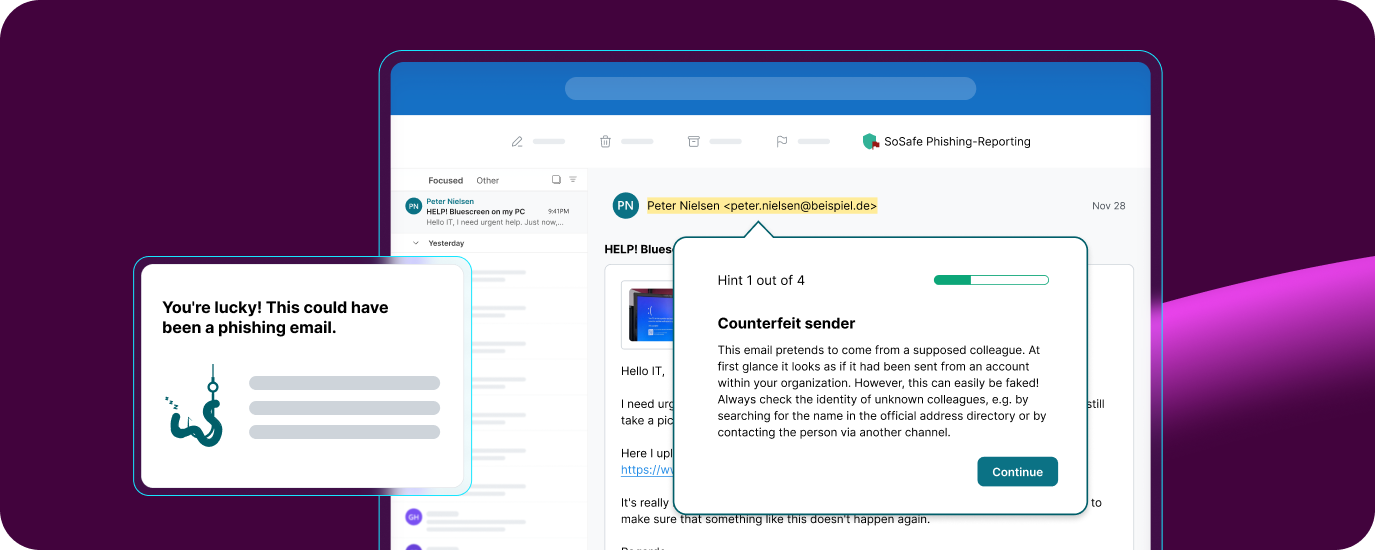
An invoice from a maintenance contractor you really do work with looks just like the ones that arrive every week. Phishing simulations by email and SMS build on everyday situations like this. In email simulations, difficulty and frequency adjust to each person’s results: people who spot the fakes move on to harder scenarios, while those who struggle get foundational guidance.
Reporting that shows behaviour change, not just attendance
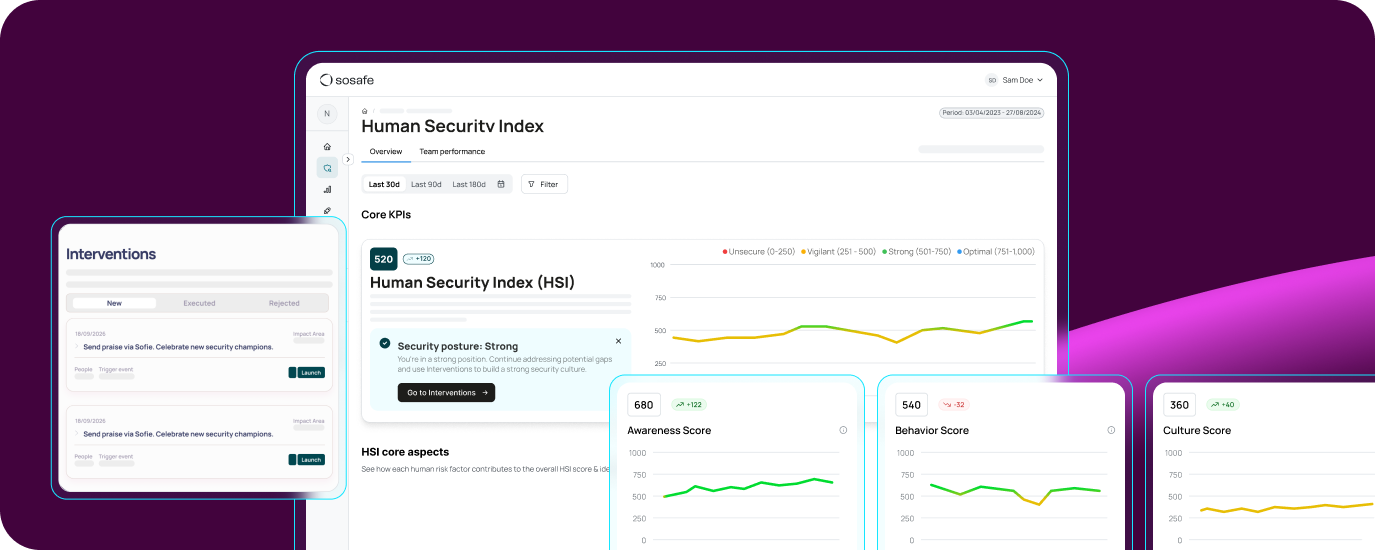
Completion rates alone say little about risk. SoSafe turns simulation results, reported threats and learning progress into reports that map to NIS2, ISO/IEC 27001 and GDPR. Management can follow human risk trends in the Human Security Index, a score built from awareness, behaviour and culture data, while the security team sees which departments need attention.
THE CHALLENGE
What energy and water utilities are up against

Phishing that looks like routine operations
Many attacks still begin with a message. In ENISA’s analysis of incidents in the EU between July 2024 and June 2025, phishing, including phone-based vishing, was the entry point in about 60% of observed cases (ENISA Threat Landscape 2025). In a utility, the lure might be a maintenance ticket, a supplier’s new invoice address, a request to confirm grid connection data or a notice about a meter replacement, sent to someone who may handle dozens of those a day.

The call to the control room
A caller says he is from the equipment vendor and needs remote access now, or from the IT helpdesk and needs a password reset before the next shift. With voice cloning, a familiar voice is no longer reliable proof of who is calling. In power grid cyber security, teams on phone, radio and mobile need the habit of verifying first.

The way in through service partners
Maintenance firms, metering service providers and IT partners often hold remote access to operational systems. For cyber security in the energy sector, NIS2 makes supply chain security a required risk management measure. When a partner’s account is compromised, the login looks legitimate, and an employee who questions an unusual request can stop it early.
Several companies, one small security team
Grid operation, energy supply, water and other municipal services often sit in separate companies, in many cases because EU energy rules require grid operators to be kept separate from supply. The security team is usually small, handles utilities cyber security for all of them and needs evidence for each one.
COMPLIANCE
Built for European utilities regulation
In utilities cyber security, what counts is proof that people act securely. NIS2 makes training part of risk management, management included, and the CER Directive asks critical entities to train their staff. SoSafe helps you demonstrate it, with reports aligned with NIS2, ISO/IEC 27001 and GDPR.


WHO GETS TRAINED
Role-based training for your entire utilities workforce
In the control room
A good part of power grid cyber security happens at the console. Operators learn in units of a few minutes, on a shared terminal or their own device, whenever the shift allows. The cases come from their own work. A vendor suddenly wants remote access. A caller reports a fault and pushes for a quick decision.
Out in the field
Meter readers and maintenance crews are out on the road for much of the day, and many of them have no company email address. They sign up and learn on their phones, and seasonal or temporary staff can join the same way. Some simulations arrive by text message, such as a new job that was never assigned or a login request they did not start. Service partners with access to your systems can be included as well.
Where payments and customer data move
Billing, customer service and procurement handle accounts and payments every day, and attackers like to imitate exactly that. Training uses the same kind of requests each team knows from its own work: in billing, a supplier announcing new bank details; in customer service, a caller asking to change the account holder; in procurement, a tender notice with a link to “view the full file”.
IT, security and management
Administrators go deeper into privileged access, remote maintenance and incident triage. Managers and executives get a shorter track built around what NIS2 expects from management bodies: approving risk management measures, following training themselves and knowing who sends the early warning for a significant incident, which is due within 24 hours.
Lessons that match the job
Content adapts to role, prior knowledge and risk profile. A control room operator gets different scenarios from a billing clerk, and people who already know the basics can move on more quickly.
Real attacks, turned into training
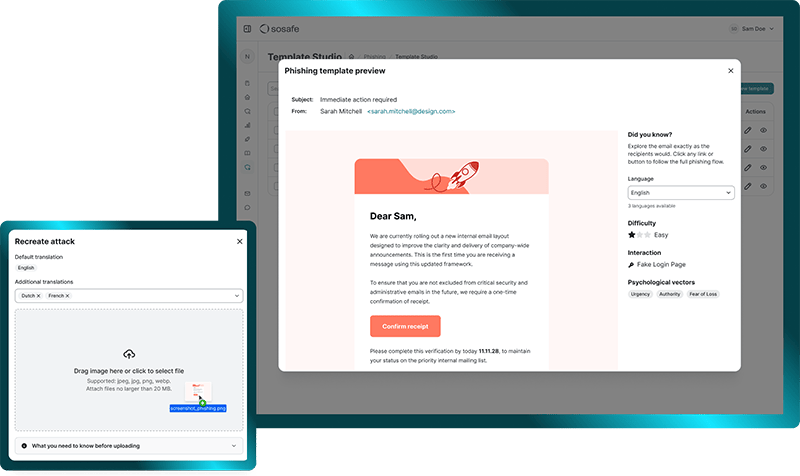
When someone reports a suspicious email, for example a fake outage notice, your team can upload it and turn it into a simulation within minutes. It then goes to the groups that received the original.
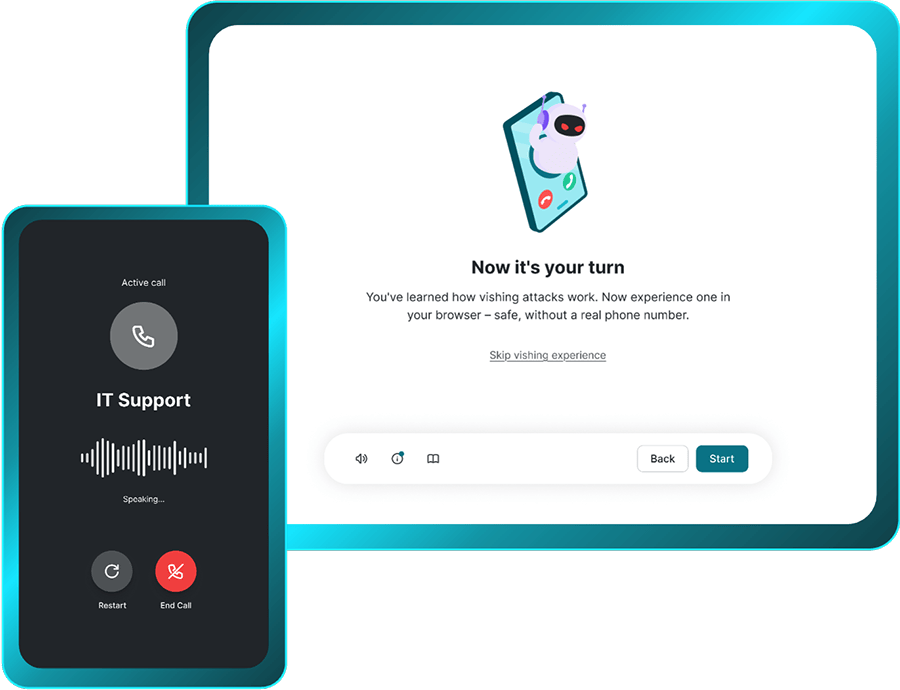
A safe first call
At the end of the interactive vishing lesson, people take a realistic, AI-voiced call in their browser and practise checking who is on the line. Nobody has to hand over a phone number. The call is part of the lesson and is not tracked like a phishing simulation.
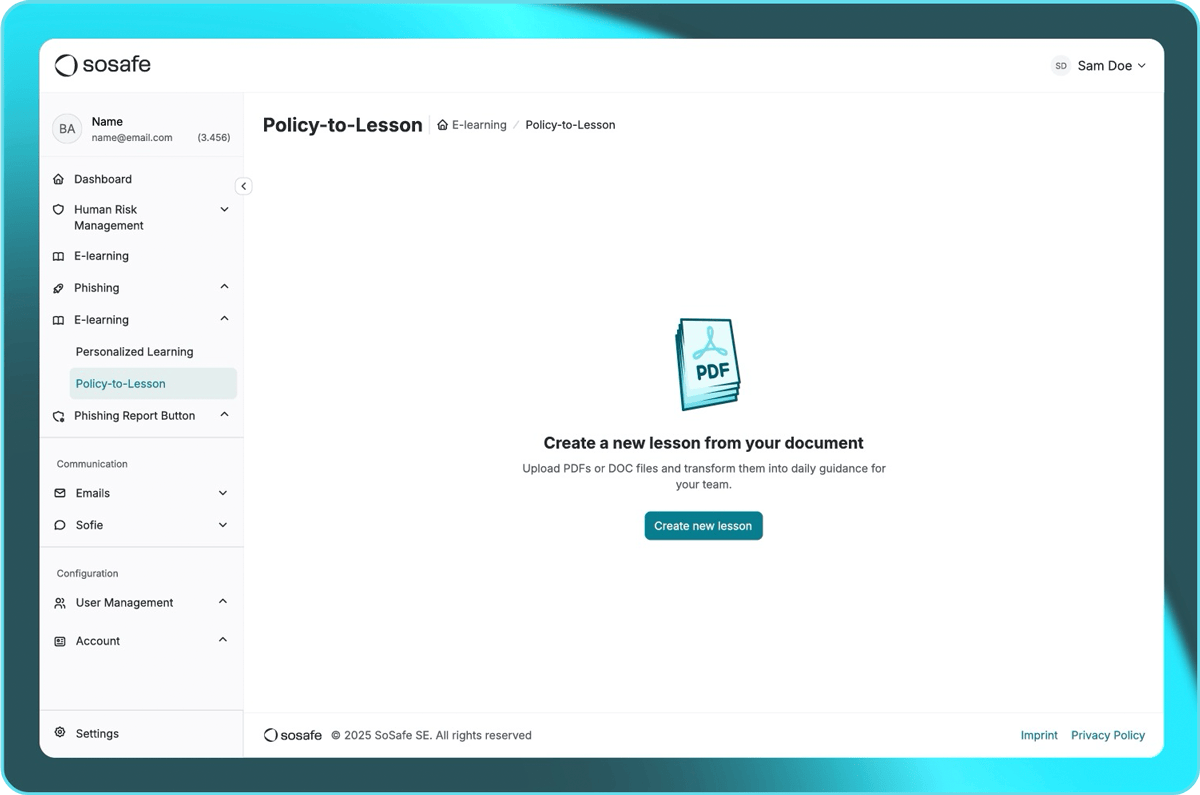
Your policies as lessons
Upload an existing document as a PDF, such as the rules for remote access by service partners. SoSafe drafts an editable lesson for your team to review, refine and publish.
Reporting in one click
The Phishing Report Button in the email client sends suspicious messages to a single triage queue. The security team sees all reports in one place and decides which ones need action.
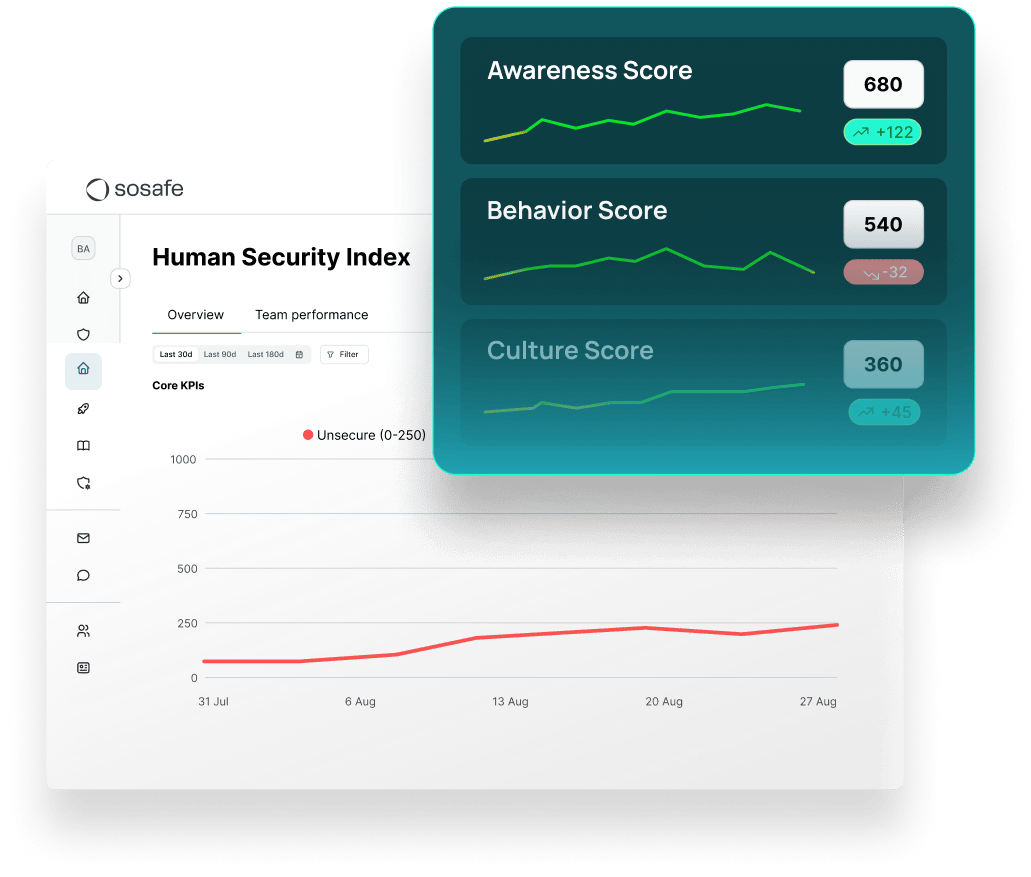
Evidence you can export
Exporting a report aligned with NIS2, ISO/IEC 27001 or GDPR usually takes less than an hour. The Human Security Index shows how behaviour develops across control room, field and office teams.

“In a crisis, no technology will help you – only resilient colleagues who keep a cool head even in such a stressful situation, apply what they have learned, and do their best to get the company back on track. SoSafe is the solution provider that helps us to get there quickly and to engage our employees in an appealing way.”

Jens Feistel
CISO at DEW21, a local energy supplier in Germany
88%
knowledge retention after 12 months
90%
reduction in risky interactions
80%
reporting threats within 12 months
15 min
per week to run the full programme

Measurable impact
Utilities cyber security is judged on evidence. These figures come from aggregated data across live SoSafe programmes.
Built to fit the systems your utility already runs
Utility cyber security has to work with the identity, email and service management tools that are already in place. SoSafe connects to them, so the programme runs inside your existing setup rather than alongside it.
Integrations
See all the integrations


Compliance
See all our certificationsGDPR Compliant
German Engineered
EU Hosted
Utilities cyber security FAQs
See SoSafe at work in your energy or utilities company










 Reports
 Guides
 Blog
 Glossary
 Perks
 Customer stories
 Webinars
 Replays
 Podcast
 All events
 Signal Security Summit
 Danger Lab
 Careers
 News & press
 Contact
