
Human Risk Management, Product
What 2026 taught us about human risk, and where it goes next
More than one in four malicious attacks this year involved AI, a 56% rise in twelve months. In our own research, 43% of organisations told us they had a shadow AI incident or near-miss in the past year. And the average breach now takes 247 days to identify and contain. The most expensive way in? Voice and SMS attacks, at an average of $5.29 million per breach.
Each of these numbers tells a story on its own. Together, they describe a shift that every security leader I speak to is feeling.
What this tells us about the future of human risk
Attacks are increasingly built by AI, aimed squarely at people, and harder to spot once they are inside. They no longer arrive only through the work inbox. They come through the phone, the chat window, the AI tool someone signed up for last week, and the supplier whose email account was compromised a month ago.
That changes what preparation has to look like. A checklist of red flags made sense when attacks were clumsy. It does not hold up against a flawless message, a familiar voice, and a request that looks exactly like ordinary work.
The anatomy of an attack in 2026
Consider how a typical attack unfolds today. Nothing about it would have tripped a traditional awareness checklist. This is a simplified illustration, but the Binance attack of October 2026 was much more complex but still used similar principles.
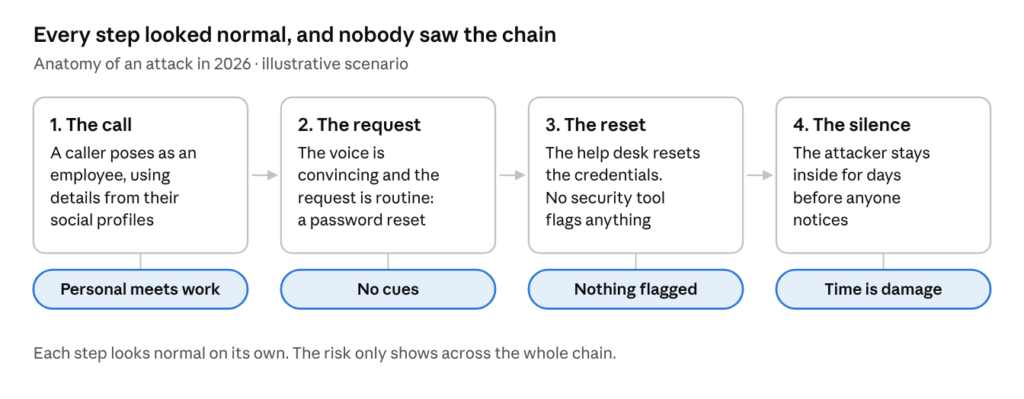
A caller poses as an employee, using details pulled from their social profiles. The voice is convincing and the request is routine. The help desk resets the password, and no security tool sees anything wrong. The attacker then has days inside before anyone notices. No single step looked suspicious. That is exactly the problem.
How SoSafe adapted in 2026
Our customers told us where the pressure was building, and much of this year’s work came straight from those conversations. Three areas mattered most.
- Recognising the attacks people actually face. Attackers moved to voice, video and messaging, so we did too. Deepfake simulations, our Interactive Vishing Lesson and Interactive Phishing Lesson with simulations built in allows employees to gain hands-on experience with modern threats, completely eliminating the need to collect phone numbers. Your workforce gets real practice on every channel, so the right action comes more naturally.
- From real threat to training in minutes. According to our research, 92% of multichain and multichannel attacks have an email component, which means employees reporting a suspicious message is still the best early warning an organisation has. Our AI-enhanced threat inbox capability filters those reports and triages so security teams can focus on what’s important. Our editable template studio then speedily turns a real attack into a reviewed, localised simulation. Today’s attack becomes this week’s training, and employees see that reporting makes a difference.
- Policies people actually follow. Policies matter, but a forty-page document rarely changes behaviour. Our new capability uses AI to turn policies into short lessons delivered where people already work, in Teams and Slack, and tracks acknowledgements for record-keeping. Admins spend less time chasing, and the evidence is there when needed.
What to expect next
The attack I described is not unusual. It shows three shifts we expect to define the year ahead:
- Attacks are personal and professional at once. Attackers build their approach from someone’s LinkedIn profile, social media and private phone as much as their work inbox. A message on a personal device can be the first step towards a company account. The line between someone’s private and work life has, for attackers, disappeared.
- The tell-tale cues have disappeared. For years we taught people to look for spelling mistakes, odd greetings and warped logos. Those signs are gone. AI writes flawless messages in any language, clones a familiar voice and fakes a video call. Spotting red flags is no longer enough. People need skills that are so well practised they kick in under pressure: pausing, and checking when something feels off.
- Time is damage. The longer an attack goes unnoticed, the more it costs, and detection is getting slower, not faster. The quickest sensor most organisations have is a person who notices something and reports it. That makes reporting speed as important a measure as click rates, and a reporting culture one of the most valuable things a security team can build.
How our category needs to adapt
These shifts ask more of human risk management. I see three things our industry has to get right.
- See more. Each security tool sees one step of an attack: the message, the login, the password reset. Each step can look normal on its own. Human risk management has to help bring those signals together, so someone sees the whole chain before it completes.
- Know the individual. The same attack lands very differently on an intern and on someone who can approve payments. Risk has to reflect the person: their role, what they can reach, and what is being aimed at them. Treating everyone the same wastes their time and leaves the highest-risk moments under-protected.
- Act, not just advise. When a risky decision is happening right now, a course next month arrives too late. We need support that is timely and proportionate, and that goes beyond a gentle nudge when the risk calls for it, always with transparency and human oversight built in.
None of this works without trust. The closer we get to how people work, the more important it is to be open about what we observe, why, and who decides. That principle has guided us since we started, and it will guide what comes next.
We’ll share more at Signal Security Summit 2026
We have been building towards this with our customers and community all year. At Signal, we will show you what we’ve been working on, how we can continue to partner together, and how we aim to help your people stay ahead of attacks that no longer announce themselves.
We would love to welcome you to the conversation in Cologne.
PS: If you can’t join us in Cologne on 18 November, you can still follow the discussions and hear directly from the experts on stage. The Signal Security Summit 2026 will also be available via livestream.
About the author

Dr. Niklas Hellemann
CEO and Co-Founder, SoSafe
Niklas Hellemann is a studied psychologist, social engineering expert, and Co-founder & CEO at SoSafe. Before founding his own company, he worked as a management consultant at the Boston Consulting Group for six years in the areas of People and Organization. Besides his Ph.D. in Business Administration, Niklas studied psychology – which led him to the human approach in the tech-savvy cyber security market. In 2018, Niklas founded SoSafe together with Lukas and Felix to strengthen digital self-defense worldwide. Today, Niklas is engaged as a speaker on various stages worldwide, including the OMR Festival, the Web Summit, and the RSA Conference, where he talks about the pressing challenges of social engineering and his learnings as the CEO of a B2B scale-up.
Learn moreYou might also be interested in:
 3 min read


Do you want to stay ahead of the cyber game?
Sign up for our newsletter to receive the latest cyber security articles, events, and resources. No spam, only content that truly matters.













 Reports
 Guides
 Blog
 Glossary
 Perks
 Customer stories
 Webinars
 Replays
 Podcast
 All events
 Signal Security Summit
 Danger Lab
 Careers
 News & press
 Contact
